

It’s the last day of Disability Pride Month, which is appropriate considering that we at Caffeinated Caregivers have been avoiding talking about this topic all month. To be honest, Disability Pride has got us up in our feels a little bit, because as disabled adults who are also caregivers to disabled kids, it brings up a lot of conflicting and confusing emotions as we try to figure out our place in all this.
And as far as we can tell, we’re not alone in feeling a little confused about how we’re supposed to engage with Disability Pride. So today, we’re digging into some history behind Disability Pride, what we’re actually celebrating during Disability Pride (spoiler: it’s not actually the pain or suffering that we or our kids endure), why it’s valuable and important to celebrate (but why it’s not more important than protecting your own energy), AND how caregivers fit into all of this.
If you’ve been confused about what Disability Pride means for caregivers, this episode is for you. Let’s get into it.
In this episode:
[00:00:00] Intro
[00:00:35] Erica and Alyssa discuss the merits present (or not) in grapefruit
[00:04:16] Why Erica and Alyssa have been avoiding this conversation topic
[00:10:57]Alyssa’s big and complicated feelings around Disability Pride (and why being a caregiver has changed how she would otherwise interact with Disability Pride)
[00:16:19] A quick history of Disability Pride Month
[00:22:53] What allyship looks like and how caregivers fit into Disability Pride
[00:30:10] Why some caregivers don’t feel like they relate to Disability Pride
[00:30:38] The life and death ramifications of untreated mental health struggles (and it’s not just about ideation around unaliving yourself)
[00:35:37] Ways that caregivers can join in the celebration and why they can let go of guilt if they don’t
[00:41:18] What we’re actually celebrating (and what we aren’t) during Disability Pride
Links:
Listen to The Accessible Stall’s episode on Disability Pride month.
See PlaySpark’s great post on how parents and caregivers fit into Disability Pride.
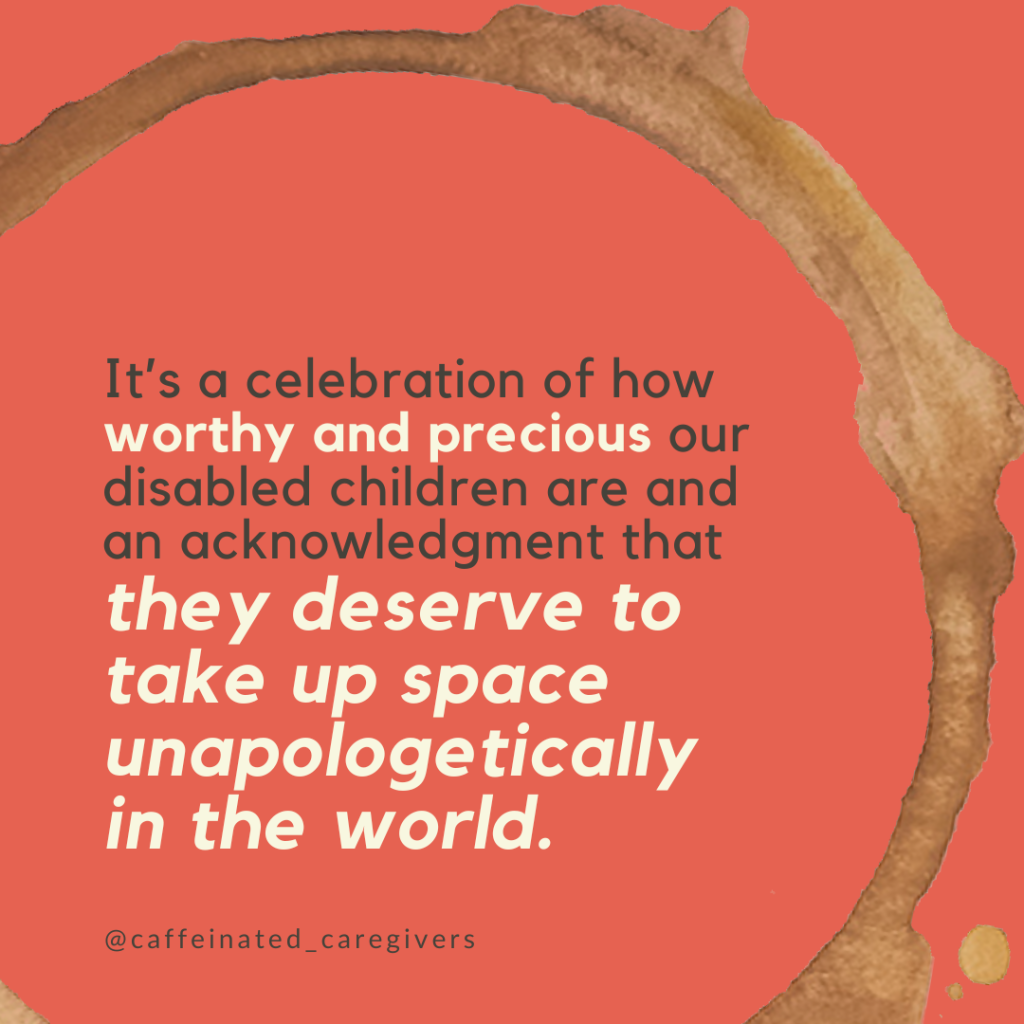
Follow us on Instagram for research, validation, and a lot of memes @caffeinated_caregivers.
And if you have a sec, leave us a rating and review on Apple or Spotify! Thanks friends! Talk soon!
Finally get the support you need as a caregiver, right in your inbox:
Transcript:
[00:00:00] Erica Stearns: This is my hot take. My children probably could care less about this stuff. You know, like disability pride for them is like, can we please snuggle all day, every day?
[00:00:22] Alyssa Nutile: All right. I’ll do one. I’ll do one.
[00:00:26] Welcome to caffeinated caregivers, where we have coffee dates and conversations about all things related to caregiving. Just so you know, that entire piece is going in.
[00:00:37] Erica Stearns: That’s it. Including the throat clearance.
[00:00:41] Alyssa Nutile: That’s the one. Alright, fine. Fine, fine, fine. Look, I even enunciated. You did great. Which is very antithetical to my midwestern upbringing enunciation.
[00:00:54] Same. Okay. Erika, are you drinking anything today?
[00:00:59] Erica Stearns: [00:01:00] Well, yes, admittedly, I’ve had my fair share of caffeine, but I could use more and I might have to pause. I’m on water right now. I’m getting my hydration. I’m trying to do more water these days. And I’m drinking out of a Stanley Cup. I don’t even own a Stanley Cup.
[00:01:20] So I’m impressed. Randy made me watch the SNL parody of the, I think it’s called like, Big dumb cup. It’s really spot on. Uh, I do like my Stanley cup. It is different from most. I’ll have to share a photo for caregivers because it’s a good cup for caregivers. What are you drinking this morning?
[00:01:42] Alyssa Nutile: Um, it’s officially noon where I am.
[00:01:45] So I’m moving on from coffee. I’m having seltzer today. Nice. I’m having polar raspberry lime seltzer. I’ll be honest. I wasn’t a seltzer person before, maybe like a month ago, like [00:02:00] a flavored water type person. I’m not a flavored water person. If it doesn’t have bubbles in it and you put anything other than water in it, I do not want it.
[00:02:07] Same. But this seltzer. is pretty good. It’s the polar brand is like more bubbly than usual, but this one like actually Tastes a little bit like what it’s supposed to taste like like my favorite one is the cranberry lime one, which I like because That to me already feels like it doesn’t have to be sweet.
[00:02:27] So Like when it’s not sweet in the seltzer, it’s not like shocking to me and the same for like the raspberry lime It’s got a hint of lime hint of raspberry a little bit tart Good. Nice.
[00:02:39] Erica Stearns: I always gravitate towards the like, pomegranate or grapefruit flavors. Those are tend to be my favorite.
[00:02:46] Alyssa Nutile: I haven’t tried the grapefruit one.
[00:02:47] I actually really like grapefruit in most things, so I should get that one next time.
[00:02:51] Erica Stearns: Okay, but do you like grapefruit as a fruit?
[00:02:54] Alyssa Nutile: Not particularly.
[00:02:56] Erica Stearns: Okay, so that’s a thing. It’s not just me. That’s good to know. [00:03:00]
[00:03:00] Alyssa Nutile: No, I don’t drink a lot of soda, but my favorite soda, if I were like forced to choose one, is probably squirt, which is also grapefruit flavored.
[00:03:11] Erica Stearns: I love grapefruit sparkling water. I love grapefruit flavored beers or sours. Those are some of my favorites.
[00:03:18] Alyssa Nutile: Yes.
[00:03:20] Erica Stearns: I actually enjoy a grapefruit fruit leather, but I don’t like grapefruit as a fresh fruit. So, it’s just a little too tart for me, I think. I don’t know.
[00:03:30] Alyssa Nutile: Okay, my thing with grapefruit is it’s got like a little bit of like a bitter aftertaste.
[00:03:35] And I don’t I don’t like that in my fruit.
[00:03:38] Erica Stearns: I’m
[00:03:38] Alyssa Nutile: glad
[00:03:38] Erica Stearns: we
[00:03:38] Alyssa Nutile: covered this
[00:03:39] Erica Stearns: important topic.
[00:03:40] Alyssa Nutile: It’s very important. Grapefruit’s an important fruit to cover. Okay, well we gotta get right to it today for a couple of reasons. One, we have been avoiding recording this episode for the entire month of July, which is Disability Pride Month.
[00:03:55] Fun fact. Second, because we were [00:04:00] like, no, this episode is really important and we do have to record it. We have one hour to record this and you guys may not know this because we do a good job editing, but like it is unusual for us to record probably less than like an hour and 45 minutes.
[00:04:16] Erica Stearns: Yeah. We pre gamed today.
[00:04:19] We had a phone call before, so that helped. And I think that will carry over into this conversation. You know, you mentioned that we’ve been avoiding this topic, and a lot of that is because we just have a lot of nerves and feelings regarding it. So I’m curious, Alyssa, what did you do between the time we talked on the phone and we came to the microphone?
[00:04:42] What did you do to kind of stress relieve or fuel slash pump yourself up for this conversation?
[00:04:50] Alyssa Nutile: Well, I said I was going to stress clean and I did stress pick up like three dishes in the kitchen, but mostly I actually just ended up [00:05:00] wandering around my house, like thinking about what I could clean for stress relief.
[00:05:05] So I did nothing for stress relief. Like my stress relief turned into like its own stressful exercise, but it is what it is. I made lunch also, and I changed my clothes. Nice. I changed out of my jammies for this, so that was, that was something. Wow. I’m, I’m honored, Alyssa. You’re welcome.
[00:05:24] Erica Stearns: It’s a big deal. I took a semi cold shower, listened to an audio book for a moment, ate lunch, and also changed out of my pajamas.
[00:05:36] So, whew, look at us! Look at us! I
[00:05:39] Alyssa Nutile: know! Nolan is wearing jammies today! Um. Is this a first? I don’t know if it’s a first, but it’s definitely a first. Not necessarily the norm to have both of us out of jammies.
[00:05:51] Erica Stearns: Yeah, this might be the last time for a long while, folks. Well, it’s a good thing they don’t see us because, [00:06:00] um, you know, this is, this is a conversation, as Alyssa mentioned, that we have had going on in the background since maybe going into the month of July, I feel like.
[00:06:14] is when I started having some feelings come up about whether or not we were going to actually take this conversation on air. And, um, you know, just to kind of set the record straight for our friends in the caregiving community, because sometimes this gets asked via private messages or, um, You know, actually somewhat blatantly at times in comments, but just as a general rule at the very beginning of forming caffeinated caregivers, Alyssa and I decided that, that there were just too many awareness months to develop content for every single one.
[00:06:55] Alyssa Nutile: We didn’t want to set the expectation that we have to [00:07:00] do awareness months of every kind. I think partially because like you said there are so many and like we didn’t want to leave any out and also like we just didn’t want to have to bother remembering all of them because there’s a lot of them. Yeah
[00:07:13] Erica Stearns: and there’s only two of us.
[00:07:16] Alyssa Nutile: And there’s only two of us and I forget things all the time, including my child’s appointment, which is why I put them on Google Calendar and have them send me alerts at least 24 hours in advance. So if I can’t keep track of that all the time, there is no way I’m going to keep track of all these awareness.
[00:07:34] Erica Stearns: And, and parents, caregivers, you also shouldn’t feel the pressure to remember that. However, for some reason, this year of all years, The month of disability pride has hit Alyssa and I in,
[00:07:52] Alyssa Nutile: oh, how would you describe it? You said to me earlier today that I was in my feels about it at the [00:08:00] beginning of this month, which was true.
[00:08:02] That is very true.
[00:08:03] Erica Stearns: Alyssa was very much in her feels about it. There were a lot of voice messages back and forth.
[00:08:08] Alyssa Nutile: I could have Made a two hour podcast just from the voice messages that I sent Erica and also at least two other groups that Erica’s in. So not only did she have to hear everything, she also had to hear it basically like three times.
[00:08:22] I’m honored. I’m honored.
[00:08:24] Erica Stearns: Meanwhile, I was ambivalent. I was just kind of not really sure how I felt. I didn’t, couldn’t quite contribute to the conscious stream of thought because I was in kind of an avoidance phase about it. So we should probably set the stage about that a little bit right now. Dear friends, if you haven’t come to realize this about Alyssa and I yet.
[00:08:56] It’s probably important to know that we are [00:09:00] two adults who grew up with disabilities. Oh my gosh, I did it again. I didn’t even say disabled adults. Listen to me. We are disabled adults.
[00:09:09] Alyssa Nutile: I know it’s hard. That’s the thing. That’s us like getting it. That’s right. At least me getting all up in my feels about it.
[00:09:15] But yes, disabled adults who were also disabled children. Yes.
[00:09:21] Erica Stearns: And I think because Alyssa and I do not struggle with things like accessibility or accommodations in the way that we used to. Our comfort in showing up to talk about disability pride and to talk about disabilities, it’s not there. We definitely don’t feel or desire to be leaders in that space, but it is content that we consume and content that we engage in because essentially that is our community as well.
[00:09:59] [00:10:00] And it’s tricky because our identities as disabled women intersect with being caregivers of disabled children. I don’t know. No, I’m going to go and say, and I know for a fact, because Alyssa, you and I have talked about this a lot. It always feels like my disabled identity comes after my identity of being a caregiver.
[00:10:28] And I think that’s because a lot of my needs as a caregiver for my child are more important and more critical than my own needs as a disabled woman. It makes Me feel, again, very ambivalent about how I show up for Disability Pride Month. Do you want to talk about your big feelings? Yeah. Do you want to share those?
[00:10:57] Alyssa Nutile: Oh my god, I had so many, so let’s, [00:11:00] let’s try and distill. I think, having gone through much verbal vomit, Um, in the last, well, I did it like towards the beginning of the month and then I went on vacation and I had time to process. So, I think the core of the issue for me is, Kind of like when I was a kid, I wrote about this and I think we’ll publish it at some point.
[00:11:22] There’s going to be part from me and part from Erica, but it’s not up yet. That, like, as a kid, there was like a disability community, right? That I could have probably, like, fit into. But there was no social model or structure for me to, like, find that or know about that or gain access to that, right?
[00:11:40] Because nobody talked about what I was going through. So, As a disability, despite the fact that like, and I had this realization later, I have other people in my family with similar disabilities, including an aunt who struggled with like mobility issues. and health [00:12:00] issues, like much longer than I did and much more severely than I did.
[00:12:04] Like it eventually contributed to like her somewhat early passing. And yet she walked with a cane her whole life. And I never, no one ever in my family ever referred to her as disabled. So it wasn’t a thing That I had access to as a kid. So there’s that aspect of like coming back around to it as an adult.
[00:12:24] And then at the same time, I think what I was saying to you earlier in the month is that despite all of that, and despite being an adult now and like understanding that like there is a space for me in there. And I could claim that it almost feels like I’ve had to like put away that part of myself because I am a caregiver.
[00:12:43] And to your point, it’s like, not only is it on the back burner, it’s almost like. irrelevant, it feels like in a lot of my day to day at this point, because it’s like, well, my disability, it would have to get so bad before it would ever even [00:13:00] like become a topic of conversation, like over my kids. And I don’t mean that in like, oh, there’s this worse than me.
[00:13:05] I mean, like, I do not have the time or energy to give it time and energy while I’m trying to take care of. my daughter who needs like 24 hour care, right? Like I just do not have the bandwidth to put the emotional energy into that. So it almost is like, it’s like a nothing burger in my life in that sense, right?
[00:13:26] Like I cannot devote any thought or time or energy to it. Really outside of these conversations. And so that kind of gets sticky at this time of month, because I’m like, well, how do I fit in here for one thing? But then also like, it feels unfair, you know, to my own identity, but then it also starts to feel like icky, like, well, if I can’t even talk about like my own disability, like how am I supposed to express any amount of pride or community or anything else?
[00:13:54] for my daughter in the broader community, too. And, you know, I’m [00:14:00] gonna go ahead and say that, like, I don’t know that I came to any, like, official conclusions about any of this, but, like, this is stuff that we’ve been working through, too. And, again, as two disabled adults, this is how we’re feeling about it, and I can only imagine how other caregivers are trying to, like, navigate all of this, if that’s how you and I feel about it.
[00:14:20] Exactly.
[00:14:20] Erica Stearns: Exactly. Exactly. I also think about the fact that disability pride itself as an event, as you know, historical moment, which we’ll go into in just a moment, that wasn’t a thing for you and I growing up. So it is, it’s new. It’s not something we grew up with that we were exposed to. And that includes not only just like the language and like the security and identifying as disabled.
[00:14:51] But also just like the idea that now, as a 39 year old, the type of access that I have to my peers in [00:15:00] that community, I did not have. It just was not even possible, you know, in the 80s and 90s. even early 2000s. So all of this feels really new and sometimes I feel like the movement isn’t mine because I am older and I didn’t grow up with that in a lot of ways, even though I know that’s, that’s not the case.
[00:15:23] So yeah, let’s talk about disability pride. Let’s talk about what it means because, you know, we recently did a poll with our caregiving community about disability pride and how people celebrate it or not and how they celebrate it. And I was really shocked to see that 50 percent of the caregivers reported only just now learning about it.
[00:15:46] I guess I’m not that shocked because I only really started learning about it, you know, when my daughter was born with disabilities. I really wasn’t fully indoctrinated into the disability community because I, you know, I [00:16:00] didn’t even really fully understand that it existed online in this capacity until 2017.
[00:16:07] So it does still feel pretty new to me, but 50 percent of the caregivers out there do not know the history behind, uh, Disability Pride Month being in July. Alyssa, would you like to share about that?
[00:16:19] Alyssa Nutile: Yeah, I’m gonna do the quick version. Basically, the day of Disability Pride, more or less, started in 1990 when the ADA was finally signed into law.
[00:16:30] July 26th, like 1990, right? Because I think they celebrated on the official day of signing. Yeah, it
[00:16:36] Erica Stearns: was this day, oh my gosh, 34 years ago. Ironically, this day. Like, we did not plan this, everybody. This was random.
[00:16:44] Alyssa Nutile: I really want to stress how much we avoided this episode and still ended up accidentally recording it.
[00:16:51] On disability pride day disability, whatever day it is. Yes.
[00:16:56] Erica Stearns: And for those who don’t know what the A DA [00:17:00] is or what it stands for,
[00:17:01] Alyssa Nutile: I know it’s the Americans with Disability Act.
[00:17:04] Erica Stearns: Yeah, . The A DA stands for the Americans with Disabilities Act, and it was a federal civil rights law. that essentially protects people with disabilities from discrimination in many areas of public life.
[00:17:21] Essentially what that means is that the ADA is designed to guarantee that people with disabilities have the same opportunities as everyone else. And I think some of my ambivalence about celebrating it is resonated in my disability community, which is that we know we’re not there yet. We know that currently people with disabilities still face an immense amount of discrimination.
[00:17:49] They do not have equal opportunities, including equal marriage rights. So Yeah, sometimes it feels hard to talk [00:18:00] about it and to celebrate it because we are so far from the ADA being what it was envisioned to be and protecting what it was designed to protect.
[00:18:11] Alyssa Nutile: Yeah, just real quick for this year for the 2024 theme, the ARC, I didn’t realize this, but there are themes.
[00:18:18] I probably should have known that there are themes to Disability Pride Month. And this year’s theme was, we want a life like yours. And I’m like, that’s great. That’s awesome. Love it. And then I pulled one more thing about like, why, what, you know, is even the point of disability pride, like broadly, like, why do people say that this is an important thing to celebrate?
[00:18:40] And I found a few things, but this was my favorite. So it’s from a marriage disability. And they said, As long as people feel ashamed of who they are, they will never realize the true equality and freedom they desire and can achieve. That’s why Disability Pride matters. That’s why you matter. So basically, it’s not that different from any [00:19:00] other, like, civil movement.
[00:19:01] It’s, in a lot of ways, like, still striving for full equality. Personhood in like the eyes of the law and society. Yeah. Right? Like people want to be seen. They want to be seen as like full humans that can do all the things and valued and, and have equal protections and equal rights and all of those things.
[00:19:20] That is the purpose of Disability Pride Month.
[00:19:23] Erica Stearns: So Alyssa, ambivalence, as we mentioned earlier, and some of your big feelings came from what we mentioned earlier, which was existing in that intersection of being both a disabled adult and a caregiver. But for the sake of this conversation, we’re going to try, and I want to stress that we’re just going to try.
[00:19:45] This is an attempt. It’s very hard to do this. We’re going to try to just focus on the caregiver aspect of this. You know, sometimes it’s hard to untangle the fact that we did grow up with disabilities and so much of our life has been [00:20:00] shaped by disabilities. That has definitely influenced how we show up as caregivers.
[00:20:06] But for the sake of this conversation, We’re going to talk about where do caregivers fit in to Disability Pride Month. And I want to start off by sharing this amazing post, which if you follow us on Instagram, you probably saw us share because I’ve been consuming a lot of social media about this topic, but this was by far my favorite one.
[00:20:30] And it was by PlaySpark. And I think I just really put words Like the words that were in my heart, hold on, that’s not how you say that. I think it puts words to the thoughts and feelings that I had surrounding this. They wrote, parents of disabled children are essential allies to the disability pride movement.
[00:20:52] Yes, yes, yes, they are. We are our children’s first introduction to the concepts of self love, [00:21:00] and self acceptance. We create our children’s first sense of belonging. We are also intimately aware of the injustices that our children face simply because they are disabled. We are frontline allies fighting for health care, accommodations, access, and dignity.
[00:21:18] Disabled people deserve so much more. We see it, we know it, and we’re here to fight for it. In the caption of that post, I think the The important part of this was that they emphasized that this is not a caregiver’s movement. This is a movement for the disability community, and it is important to defer to their voices.
[00:21:42] And that’s where it gets a little sticky for me, right? Because I’m like, Oh, but that is my voice. And yet it is hard for me to speak about this because my disabilities are so different from my children’s. in that, you know, I maybe couldn’t always [00:22:00] advocate for myself or even speak, but now that I can, I am very sensitive to the fact that my children will never be able to show up to disability pride the way I have the opportunity to.
[00:22:17] As that adds to kind of the conflicting nature for me, is that like, okay, well, since I am able, I should, But I’m choosing to instead step back and make space for everyone else. And if I’m feeling that as someone who is a caregiver with disabilities, I know for a fact that caregivers without disabilities are feeling the same way.
[00:22:39] So, that leads me to question, how do caregivers show up as allies in this movement? Where do they fit in? Alyssa, what are your thoughts on that?
[00:22:53] Alyssa Nutile: Well, I, I think it’s worth noting that like, this is not a movement, like specifically for caregivers, right? [00:23:00] It’s also, it gets very sticky because again, it’s not our month.
[00:23:05] And that’s even like weird for me to say it’s like, it’s not my month on the caregiving end. I guess it is my month on like the disabled adult end. But again, that’s like a harder identity for me to reconcile with nowadays. Or, like, recognize myself in, since so much of my life is taken up by caregiving.
[00:23:24] So I think the hard part for allies, which would be the caregivers in this case, is, like, making space for our kids, but also, like, not overshadowing them. Am I making sense here? It’s very it’s hard. Like, it’s hard to, like, put into words, because I don’t know that I have any prescriptive thing of like, Oh, if you do this, this is doing it right.
[00:23:48] And if you do that, that’s doing it wrong. And I’m sure there are right and wrong ways to do this. But I also think it’s very nuanced. So I’m not going to sit here and like give you like the rules or whatever,
[00:23:59] Erica Stearns: right? We [00:24:00] don’t have those. We’re not here for that. We don’t have, we’re not the rule makers.
[00:24:03] Alyssa Nutile: We don’t.
[00:24:04] So coming back around to that, there’s no rules. That we’re going to give you, I think every movement like has allies, right. And you can look to other movements to see basically a good representation of like, all right, what would it look like to be a good ally in this situation? Right. Like there are movements that are, you know, like month celebrations that are older than disability pride.
[00:24:29] Right. Like, I think we have both at various points looked to like the LGBTQ, Pride Month as sort of like somewhat of a blueprint for like how people who are not really part of the community can show up in support of the community. Even that feels like a little bit sticky to me, right? Because I have family members that are in that community and I like to show up for them and I want to do everything that I can to like support them.
[00:24:57] But at the same time, their identity [00:25:00] doesn’t really affect my day to day life, right? Like if I have a family member who’s queer, like that doesn’t show up in my daily life as a thing that makes a difference, if that makes sense. As a caregiver, having a child with a disability completely transforms my life.
[00:25:18] every day. So it’s much more intimately related. So like, even the ally aspect is like a little bit of a misnomer, because I think it implies that you’re kind of on the outside in your own thing, coming into like a movement to help strengthen it, wherein, like, we’re kind of embedded in disability every day, whether or not we even have one ourselves if we’re in the caregiving position.
[00:25:45] So I think there’s a few things. I think when you’re thinking about being an ally, one, being mindful of like, not like speaking over people who are deeply embedded, like in the disability [00:26:00] movement, taking time to maybe like listen to some new perspectives to broaden your horizons a little bit like that’s disability pride month is a great month to do that because there’s a lot of disabled adults out there.
[00:26:11] talking about their disabled experiences and also what they like or don’t like, what they feel pride in, what they don’t feel pride in, like what they want to change, all of those things. There’s a lot of discourse around that in the month of July, and that’s a great opportunity to listen.
[00:26:29] Erica Stearns: Listen, learn, share, kind of the passive activism.
[00:26:34] Alyssa Nutile: Mm hmm. Use discernment because again, if 20 percent of people in the U. S. have a disability, not everyone is going to agree. Mm hmm. So, you know, I can’t tell you like who’s saying the right things and who’s saying the wrong things all the time. So. So there’s that. I think the other thing too is during disability pride months, I keep saying that, but I’m really like, just talking about disability pride broadly all year long, like [00:27:00] in this one, starting to recognize, and I think this was the thing that like I worked through a lot in this month in particular, but like recognizing not just like the internalized.
[00:27:14] ableism that shows up out in the world, but like internalized ableism that we have for ourselves, right? Like one thing I had to reckon with a lot this month is like, why am I so uncomfortable thinking about taking up space? In the disability community or why am I so hesitant to like even say I have a disability or I was a disabled kid and I’m a disabled, like, what is so uncomfortable about all of that.
[00:27:41] And a lot of it’s just like stuff that we grew up with. Right. And I would guess that even for caregivers, like there’s still probably stuff that you grew up with, but like, you don’t need to feel this is not a time for you to like sit back and be like, this are all the things wrong with me and I should feel guilty.
[00:27:54] It’s not about that. It’s just about recognizing like. This is a belief that is [00:28:00] embedded that I can let go of now. Yeah. Like, and just let it be that.
[00:28:04] Erica Stearns: Doing the work to unlearn. Mm hmm.
[00:28:06] Alyssa Nutile: Right. Without, like, shame or guilt or whatever, just, like, let it go. Like, old beliefs, like, now’s a great time to, like, reconsider and let go what doesn’t serve you anymore.
[00:28:14] And, like, what doesn’t serve the people around you, what doesn’t serve your kid, the disability community broadly. It’s a great time. Agreed. I love that. I have one more, a little note for allyship. I think one thing that like we can do as caregivers, because I find myself, actually I don’t do this very much anymore, but I did kind of like at the beginning and now I’m over it and I think a lot of people have to like work through this at some point, but like, I think No more apologizing for accommodations that your kid does or doesn’t need or for taking up space or for being in a place or for other people having to like make just a little bit of room for you.
[00:28:54] You don’t have to apologize for that anymore. And actually this might be a great month to stop apologizing. Like just tell people like, [00:29:00] we’re coming and, uh, we’re going to need this to attend this event, or we’re going to be in this place and we deserve to be here. So like, get off my swing, non disabled children, because there’s literally only one swing here that my kid can be, you know, like that kind of stuff.
[00:29:16] I don’t know. Come up with your own examples, but like, this is the month. To stop apologizing.
[00:29:21] Erica Stearns: Stop apologizing and maybe also stop overcompensating. Because as caregivers, I find myself personally overcompensating trying to please and impress people so that they value me and my child. Equally as they value non disabled, let’s say, patients, you know?
[00:29:45] Stop that. First of all, your child is valuable and worthy and you deserve that respect regardless. So, Stop feeling like you have to always be polite and always be, you know, [00:30:00] overcompensating of your personality in order to win over professionals or providers in your lives. You know, something that came up when we polled our community was this idea of not really feeling prideful about their child’s disability, a disability that may lead to a limited life.
[00:30:24] It may have involved a lot of pain, a lot of hardship. It may have resulted in a not so great quality of life because of maybe constant hospitalizations and illness and procedures that are uncomfortable. And I think it’s fair to acknowledge that It’s okay if you don’t feel pride in that. In fact, there seemed to be a common theme I saw this year in my disability community, which was a lot of content centered on the fact that it’s okay if [00:31:00] you don’t feel pride.
[00:31:01] about being disabled. There’s still a way to honor disability pride month and a way to spread or like exemplify disability pride without being proud or happy of the disease or disability itself. And that can look like sharing the unlearning that you’ve experienced. But the other thing I just want to stress is like acknowledge as a caregiver.
[00:31:30] Your allyship is exemplified in the advocacy that you do every single day, probably multiple moments throughout every day. And that’s enough too. Even if you’re working through your feelings about how to talk about it, educate others, you’re setting an example in your family of disability awareness and disability pride for continuously fighting for [00:32:00] better outcomes.
[00:32:01] and improved rights for your child and other children and adults with disabilities. So, you know, I don’t mean to end this on like a flowery note, but that’s the reminder that I need that I needed this month, that I needed this month, regardless of how ambivalent I feel, regardless of how unqualified or, yeah, I think unqualified is the right term, how unqualified I feel to maybe engage in certain discourse about the disabled experience.
[00:32:43] I still am showing up all the time, every day, to make systems better for my kids and the caregivers involved in the lives of people with disabilities as well.
[00:32:55] Alyssa Nutile: Yeah. And another barrier that we heard, kind [00:33:00] of like two parts of this, there’s the aspect of like not feeling welcome or, uh, Not feeling like this is a movement that like you’re allowed to jump into or a celebration that you’re allowed to jump into, which I think we kind of covered, honestly, like when you and me were just working through this or particularly me.
[00:33:18] But one other aspect that I think is kind of forgotten about sometimes is that part of the reason I don’t think a lot of caregivers super identify with disability pride month is because they don’t really see their kids represented in disability pride month. And I think I’m there too, right? What you see during Disability Pride Month is a lot of disabled adults, particularly in online spaces, who tend to be like fairly eloquent, good advocates, oftentimes activists.
[00:33:50] people who can do, you know, a fair amount of intellectual work for themselves, showing up and explaining their experiences with disability and [00:34:00] talking about their lives and like what they would like to be different and all of those things. That’s super important. And that should be there and available and accessible for all of us.
[00:34:11] But it isn’t particularly representative of my daughter. Yeah. In the way she navigates the world. So that gets a little tricky, right? Because it’s like, well, I see that. I see what they’re advocating for. What they’re advocating for is incredibly important. And I would never disagree with that. But, you know, like even when we talk about disability accommodations in the workplace, I want those, I want those for everybody.
[00:34:40] But it’s also probably not a thing that my daughter’s ever really going to have to meaningfully engage with. So I think the one aspect that gets lost is just like, well, There’s maybe not as broad of representation of disability. Well, honestly, like full stop [00:35:00] everywhere, but like particularly during disability pride month for like kids like ours in a lot of ways.
[00:35:06] Erica Stearns: I also, this is my hot take, I also want to honor that my children probably could care less about this stuff, you know? Like, disability pride for them is like, can we please snuggle all day, every day? They’ll be fine. And like, that is a very, legit way of celebrating disability pride for our family. It’s doing what they want to do.
[00:35:32] It’s giving them what they want.
[00:35:34] Alyssa Nutile: Gemma’s celebration of disability pride will never be going to a disability pride like parade or rally or anything like that. Strictly for the reason that it is outside and she does not like the outside. Like as a concept, she is not an outside girl. Like I don’t know what to tell you.
[00:35:53] It’s not her thing. And she will tell you, she will let you know.
[00:35:57] Erica Stearns: So it was interesting because in [00:36:00] our poll, when we asked how people celebrate, there was a very low number of responses, a historically low number of responses, which tells me People don’t really know how to celebrate, which relatable, right?
[00:36:16] That’s what we’re here talking about.
[00:36:18] Alyssa Nutile: Yeah. So there were two people that waved flags and then someone who does it every day.
[00:36:24] Erica Stearns: Loved the idea of the flag. Love just talking about celebrating that pride every day through the normal things that they do. One person mentioned like making signs and buttons and attending a march or rally, their local library.
[00:36:39] Love that. I bet that person probably lives in a larger city or nearby a larger city that does have more community organizing for events like that. For those of us that are more rural, even living in a university town, I didn’t see a single disability pride event this month. [00:37:00] So. There’s that. Um, something that felt really, like, relatable, like, I felt this in my bones when I read it.
[00:37:13] A caregiver wrote, I’m just so tired. And I think if I’m being really honest with myself. I think by the time July rolls around, specifically this day, the end of July, I’m exhausted. I’m done. I’ve reached my like max capacity of spoons to give for being social, for doing outings, for being on the road. And I think that is an act of self preservation and pride that we need to acknowledge that sometimes we ourselves should not be.
[00:37:56] burning ourselves out. I don’t think you can do any movement [00:38:00] justice if you’re showing up so completely exhausted, or if you’re sacrificing your own well being to be a part of it. And I think of all movements and communities, the disability community is probably the one to be most understanding and empathetic of that.
[00:38:18] guarantee yet.
[00:38:19] Alyssa Nutile: Yeah, for sure. And let’s be clear to like, on that note of like, just being tired, it’s not even being burnt out from every, every movement that’s already gone on every celebration that’s already happened by July. It’s just probably being tired and burnt out from every day, right? Like, if every day, Is a little bit of a struggle to like, keep your kids as healthy as they can be and like fed and do all their exercises and get them to all their appointments.
[00:38:45] Keep them alive. Keep them alive. Keep them alive. All of this. And then this month shows up every year and it’s an important month, but you’re also like, yeah, but is it more important than keeping my kid alive? Like, I don’t have, like you said, [00:39:00] the energy to put into celebrating this right now, when like, we are just.
[00:39:05] Gettin through every day. Like, this is not a thing that we have any energy or time or I have any capacity to like, even work through mentally and emotionally and like, yeah, that’s all right. It’s all right. You don’t have to pay attention to it if that’s where you are. Like, it’s not a requirement. It also has no bearing on whether or not I should know.
[00:39:28] You’re a good disability advocate or not, if you do or don’t celebrate Disability Pride Month. That’s not a requirement for that.
[00:39:37] Erica Stearns: And with that said, there are some things that caregivers can do passively, easily, from the comfort of their home, their couch, their bed, uh, heck, the changing table, although I would encourage you not to take your phone to the changing table.
[00:39:53] Alyssa Nutile: Listen, I’ve done it. I’ve learned that one the hard way. Yeah. More than once. [00:40:00] You think you would learn, like, after the first time. You’re like, Oh, I’m not going to bring my phone because then I won’t have to clean poop off my phone again. But you will.
[00:40:09] Erica Stearns: You will. You’ll do it again. Definitely. You know, things like we mentioned earlier, learning and unlearning, so listening to the voices within the disabled community, engaging in their content, at least reading it, learning about disability history, learning more about the civil rights movements have really culminated in disability pride.
[00:40:32] We will be sure to throw some links to some content creators that we tend to enjoy. But again, as Alyssa mentioned earlier, that doesn’t mean that’s every person in the community. These are just ones we happen to know personally or follow, like their content, engage in it. There’s so many, even just like hashtagging disability pride and searching that and seeing the content that comes up is one step towards, [00:41:00] you know, passively.
[00:41:01] entering that community as an ally, learning from what they have to share, and then slowly integrating some of those lessons into your own life and language and lessons that you’re instilling in others, including your children. As like other people mentioned, it’s an everyday way of celebrating disability pride without exhausting yourself.
[00:41:26] It’s, uh, it’s little A activism compared to big A activism, but it’s still activism. All the same, right?
[00:41:35] Alyssa Nutile: Yeah. As we’re wrapping up here, I think I just want to like point out like one little thing. I think part of the discomfort for disability pride Is the fact that like pride is like a little bit of a misnomer I think in this case When it comes to pride, first of all, you can take pride in your disability.
[00:41:53] There’s nothing wrong with that for being like, yeah, I’m proud of exactly what I have, but like, we’re not necessarily saying that, like, [00:42:00] you have to be proud per se that like your kid’s in pain every day or like those types of things, like the pride is more the aspect of, like, I think like taking up space kind of.
[00:42:15] Thinking about it that way, like being willing, being able to like show up in spaces, being able to like take pride in your humanity, no matter what it looks like, right? Like it’s pride in like personhood, not pride in the like disease or disorder or disability or whatever. Does that make sense? Am I explaining that?
[00:42:37] It
[00:42:37] Erica Stearns: does. I think it’s also, you know, pride for how far we’ve come. Pride for the work that has been done before us and that continues to be done with us now and what we hope will carry forward. One thing we said many episodes ago was just the emphasis on using the word disabled as [00:43:00] being a part of disability informed, and that in and of itself is an identity.
[00:43:05] So I say this to you and me, and I say this to caregivers as well. It’s having pride in using that word and not being ashamed of it and knowing that there’s community within it, whether that community be for your child or, you know, their peers and the families that surround them and support them, their allies.
[00:43:28] It’s having pride in knowing that exists now, even if it hasn’t always existed. It does now. And I think if there’s one thing I feel, and I’ve felt since my daughter was born, is pride in that. It’s knowing that even if I didn’t have that growing up, she has that. My son has that. And I do want to find ways to To celebrate that right, maybe by next year, we’ll be approaching this conversation with better ideas, uh, maybe [00:44:00] better feelings surrounding it, you know, all this is an evolving experience.
[00:44:04] So who knows? Hopefully we’ve got something more for you guys,
[00:44:09] Alyssa Nutile: right? And I think like, we’re still in that period of like, when it comes to disability pride, we’re still in the process of like, stripping away the layers of shame that surround disability for a lot of people, right? Like either internal, external, implicit, explicit, all of that, right?
[00:44:29] Because there is still a lot of like societal shame surrounding it in the way that we talk about it in the way that we don’t want to talk about it in the way that we don’t want to see it in the way that people are like, it won’t be me though. And you’re like, well, science says, It might be. In fact, it may be likely that you will eventually be disabled.
[00:44:50] You know, all of that. Just continuing to like pull away those layers of like, there is nothing to be ashamed of. And again, there is nothing that you have to apologize for [00:45:00] you or your child for being disabled for having a voice in the community for advocating for disability rights. Like there’s no, there’s no apologies that need to be made for that.
[00:45:10] And it’s just about, like you said, embracing moving forward, I think. And like, even if things aren’t perfect, like we’re trying to make it better. than it was for us, right? So, that’s the pride aspect. It doesn’t have to be like, Yay! I’m so happy for this disease that is limiting my child’s life. That’s not the pride that we’re celebrating for this.
[00:45:34] Because, I mean, me personally, I don’t think I’ll ever, like, be celebrating that. Why would I celebrate that? The disease aspect. Who would? No one would. I hate seizures. You know, like no. Yeah, absolutely. Fuck seizures. 100%. Amen. For sure. Yeah. So, you know, if that’s a thing that you’ve been struggling with to kind of reframing the way that you think about like what you’re proud of, that’s enough.
[00:45:59] That’s what this [00:46:00] is about.
[00:46:00] Erica Stearns: I love that. That’s a great note to end this on. So I guess with that said, may we all find a little strength to celebrate disability pride in whatever way feels right for you. This month, every day, every year, moving forward. May the force of all that be with you. And goodbye. And scene.
[00:46:25] Bye!
