
What (or Who) is a Caregiver?
Let’s go with the most basic definition to start: a caregiver is anyone who provides care to another person.
And then here’s a more formal definition from the Family Caregiver Alliance (this organization primarily focuses on adult caregiving relationships, but it’s a good definition anyway!)
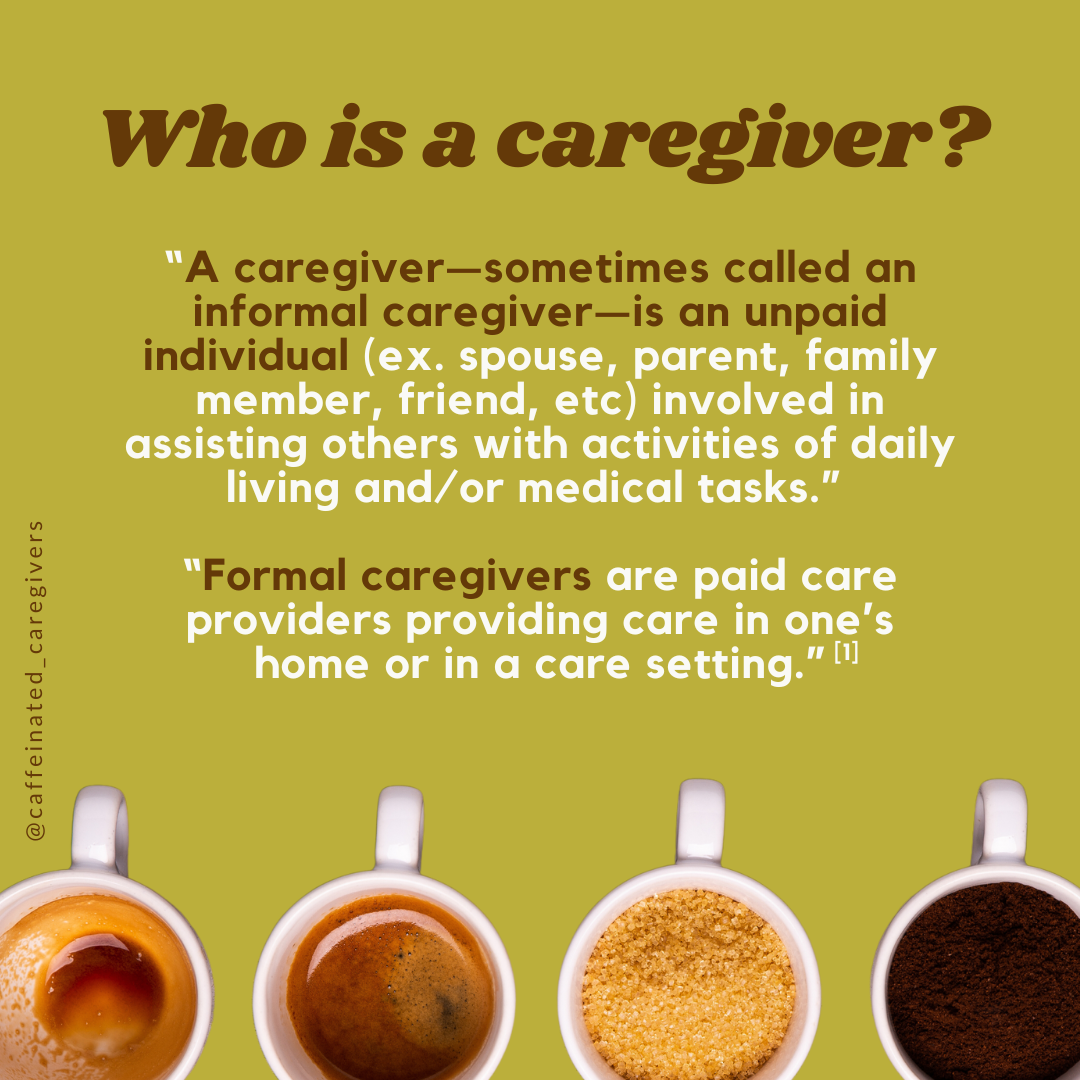
“A caregiver—sometimes called an informal or unpaid caregiver—is an unpaid individual (for example, a spouse, partner, parent, family member, friend, or neighbor) involved in assisting others with activities of daily living and/or medical tasks.”
“Formal caregivers are paid care providers providing care in one’s home or in a care setting (day care, residential facility, long-term care facility).”
Okay, obviously. What does that mean in this space though?
Well, here at Caffeinated Caregivers, we’re most often referring to pediatric caregiving for disabled and/or medically complex children. That could include parents, siblings, extended family members, foster parents, guardians, or any other adults in a disabled child’s life that is responsible for their well-being. It does, most often, tend to be parents providing this care though.
Again, in the context of Caffeinated Caregivers, the type of care provided can include medical care (sometimes hospital-level in an at-home setting), daily and routine care beyond the “typical” needs for most children, educational advocacy, medical advocacy and management, and more, nearly always in an unpaid capacity.

How does being a caregiver differ from other relationships?
Let’s get something out of the way first: Most of us do not have one single label that defines our identity, role in society, or relationship to our families. We pick and choose different terms and labels depending on context, relationship to our audience at a given time, or role that we’re playing at any given time.
For example, I could describe myself in at least ten different ways right now: mother, wife, sister, disabled person, swimmer, writer, advocate, caregiver, friend, artist, partner, etc. Nearly all of those labels overlap, intersect, and work together to create the holistic way I view my identity. So when we talk about caregiving, keep in mind that we’re considering this identity to be in addition to parent, guardian, or whatever, not as a replacement for that familial role.
So with that in mind, here are just some of the reasons that the role of a caregiver is different from other roles.
Parenting and Caregiving are just NOT the same thing.
Again, the roles of parenting and caregiving often overlap, but they are distinctly different. I could go on about how the two things are different forever, or you could just read this article by Erin Croyle that sums it up better than we ever could.
Caregivers have different needs than other familial or guardianship roles.
Okay, again, if you didn’t read Erins Croyle’s “Caregiving and Parenting Are Not the Same,” I’m gonna need you to stop, go back, and read it (It’s a fast read, I swear.) Because caregiving and parenting are so different, the needs of each group when it comes to societal and policy support are also different.
Again, there is crossover of course, but let’s take education as an example:
It’s understood societally that local governments should and are required to provide adequate schooling options for the children in their district. For most parents, this means a functional and safe school building, accredited teachers, ample classroom options and extracurriculars, bus routes, and perhaps additional educational support for below-benchmark students among other things. There may be additional needs, but I’d argue this pretty well sums up what most parents understand educational systems should cover.
Caregivers may need all of those things, but they may also need therapists and special education teachers to provide in-home education for children who cannot attend school, specialized classrooms that account for the different needs of disabled or medically complex children, different vehicles for the transportation of their children, additional hiring for nurses or aides to support their children in an educational setting, and very detailed medical care plans that can be enacted for their children in their educational setting.
And that’s just what I came up with off the top of my head. I’m certain there’s more here, and I’d like to see you try to convince me that all of this is in the scope of what most members of society –and more importantly, most policy-makers– consider to be within the scope of “parenting.”
Caregiving for medically complex and/or disabled children does not have a defined end point.
In the context of pediatric caregiving to medically complex and/or disabled children, the caregiving portion of the parent-child relationship is undefined and indefinite. Pretty much all parents are primarily caregivers at some point in their life (often when their kids are infants), but they tend to grow out of that role relatively quickly. In our societal understanding of the parent-child relationship, it’s assumed that eventually children will become independent and outgrow the daily care that they need from their parents. In many circles, that’s a marker of “parenting success.”
But when it comes to the parents of medically complex and/or disabled children, that expectation does not exist, and oftentimes the opposite is true. Instead of having a few years where our children are completely dependent on us, for many, this aspect of caregiving does not end as long as we and our children are still alive.
In short, for most families, parenting never ends, but caregiving does. But in our case, the two roles tend to be concurrent as long as both we and our disabled children exist.
Caregivers can sometimes be paid for their role, even in a familial setting.
This is not exactly commonplace yet, but in some states, parents who have had to give up their careers due to lack of childcare or qualified in-home nursing care can be reimbursed by their state to provide medical and other caregiving support to their children. In this context, it’s important to be able to define clearly how the role of caregiving differs from the parent role, because while parents often receive tax benefits, the needs of caregivers far exceed what governmental support is offered to “typical” parents.
And that brings us to our next section….
Why use the term caregiver?
Okay, elephant in the room: Why do we prefer the term “caregiver” when we could just say something like “parents of medically complex and/or disabled children?”
I mean, for one thing, that’s a mouthful, but we actually have a whole bunch of other reasons too for the next time someone asks you the same question:
“Caregiver” is an inclusive term.
Again, while most of us providing pediatric care are parents, not all of us are. (Feel free to refer to our definition at the top to see who else is included.) And we need that inclusive umbrella when it comes to policy and advocacy language so that caregivers who aren’t parents can still receive the support that they need.
On that note…
“Caregiver” is the most useful term to describe our needs for policy and advocacy purposes.
Caregivers need help. And the help that caregivers need is again distinctly different than the help other relationship roles need. Caregiver is a word that can be used in policy too. Let’s be honest, you’re not going to see “disability parent,” “special needs mom,” or even just “parent” on legislation that is geared toward our population. We need a term that carries the weight of all the support we need, and “caregiver” best encapsulates that.
And let us not forget that while we’re usually referring to pediatric caregiving here at Caffeinated Caregivers, there is advocacy needed for other types of caregiving too (adults who care for aging family members, etc.) The language and progress we make in our space can be beneficial to these tangential groups as well.
Using the word “caregiver” helps me differentiate from when I just want to be a parent.
Allow me to get emotional for a moment: I don’t really want to think of myself in a parenting role when I’m holding my kid still for her the third try to get her IV in. I don’t want to think of myself as mothering when my child is turning blue as I desperately suction her airway. And I want a way to differentiate my parenting work from my caregiving work when our in-home nursing staff comes to take over the care role each day.
Let me be clear, I understand perfectly that parenting comes with unpleasant aspects. I know it means that sometimes we have to make our children uncomfortable to help them grow, learn, and recover.
But, if needing another identity to be able to separate myself from being a part of the intense medical trauma my daughter and I have endured is wrong, then I don’t want to be right.
Ideal or not, being able to think of myself as a caregiver who is helping my child recover instead of a mom who’s contributing to pain being inflicted on my daughter helps me get through those incredibly difficult moments.
“Caregiver” helps us find and cultivate a community.
As the parent or guardian of a disabled and/or medically complex kid, when was the last time you felt welcome or understood in a “typical” parenting Facebook group or forum?
The ones where all the moms are comparing their child’s milestones (that your child isn’t meeting), crowd-sourcing childcare options (none of which have special education classrooms), or arguing over which park is the most fun (and you can’t go to any because they aren’t accessible)?
When it comes to finding our people as the parents of disabled and medically complex kids, “Mom/Dad/Parent” doesn’t really bring us the crew we need.
But “caregiver?” That’s a role that many of us can see ourselves inhabiting, and it helps us to find the people who experience life in a similar way we do, who understand the struggles we face, and who are advocating for similar things to improve the lives of our disabled children.
“Caregiver” is an outreach term, not one typically used at home.
Okay, I’ll be honest: I don’t run home and scoop up my disabled daughter every day while cooing into her ear “Hi Baby! Your favorite caregiver is home!” I’m her mom. I call myself her mom to our family, friends, doctors, therapists, and more.
Mom is a personal term that speaks to the close, loving relationship that the two of us have. But caregiver is the term that I use when I talk to a wider audience.
(If you’re somehow still asking yourself why… Go back and read everything up until this point again, friend.)
It’s the term that speaks to the very specific needs that my daughter and I need from government, from educational and medical systems, and from society at large. It’s an outreach term that serves a very specific purpose, not a term that describes every aspect of who I am to my daughter. And becoming comfortable with terms like this is critical to being an effective advocate.
After all of this, if you still don’t think of yourself as a caregiver or feel comfortable with that term… that’s okay!
Language and identity is very personal, and I don’t need everyone to agree with me all the time. But having a variety of descriptions, terms, and frameworks to be able to describe your life and advocate for your needs as the parent/guardian/caregiver/person of a medically complex or disabled child is ultimately going to be very beneficial. And we feel, here at Caffeinated Caregivers, that the term “caregiver” is the most efficient and carries the most weight.
So if you don’t feel like the word “caregiver” describes your role and your needs, that’s fine. But we’d encourage you to think long and hard about the words that will help you get more access and support, because at the end of the day, that’s what we’re all working toward together.

2 thoughts on “Here’s why we call ourselves “caregivers” (and why you might want to too!)”