

I can still feel the summer of 2015 in my bones, when everything began to fall apart.
The moment when my carefully constructed, seemingly perfect life shattered. Even now, fragments of that time float up, like bubbles rising to the surface, bursting with sharp memories that make me wince, my eyes welling up with tears.
As a caregiver to my son, my role began the moment he was diagnosed with mitochondrial disease (SIFD syndrome) in the spring of 2015.
I remember lying on a stiff hospital cot at Lurie Children’s Hospital, watching fireworks explode over Navy Pier through the haze of my dry contact lenses. My son burned with fever beside me, curled in my husband’s arms.
I remember sitting in the hospital cafeteria, surrounded by clowns and dancers from the Circus of Puerto Rico, bursts of bright colors colliding with the heavy reality of sick children all around us. They floated through the rooms, their cheerful costumes and painted smiles clashing painfully with the exhausted faces of parents and children fighting battles no one signed up for. It was a strange reminder that, in life’s darkest moments, even the most well-meaning attempts to bring joy can feel distant and surreal, as if happiness is being forced into a space it no longer fits.
In that moment, the sheer irony hit me. A hospital full of sick children shouldn’t need clowns, and yet here they were, embodying the paradox of our existence: trying to inject light into a world overwhelmed by shadows. And there we sat, in the eye of the storm. My husband, the strong, steady man I’d leaned on for seven years, was sobbing uncontrollably, unraveling under the weight of it all.
I woke up every morning with panic surging through my chest, dragging me from restless sleep into another day of dread. Even simple outings, like taking my 4-year-old daughter to the playground, became unbearable. I would watch the other children run and play, silently calculating their ages. And every time, I would ask their parents, “How old is he?” It was like twisting the knife in my heart. Each answer was coupled with a painful reminder that my son, who could barely sit up, was falling further behind.
Grief pulled me into dark places I didn’t know existed.
I emerged from those depths as someone entirely different. And yet, even as I changed, I couldn’t stop asking myself the same questions: Am I doing this right? Could I be doing more? Could I have prevented this? The guilt gnawed at me, convincing me I’d failed.
Balancing the needs of both my children often felt impossible. I remember the day my daughter threw herself on the floor, crying, “Don’t go, Mommy!” as I prepared to return to the hospital. I collapsed beside her, I was torn in two. One part of me was aching to stay with her, the other was desperate to be with my son. I could feel my heart splintering under the weight of it all.
In the midst of heartbreak, I discovered strengths I never knew I had.
I kept taking my daughter to playdates, birthday parties, and movies. I kept smiling through the pain, determined to give her a sense of normalcy. I kept moving forward, kept loving, kept breathing, for both of them. I sang “Here Comes the Sun” to my son, savoring the rare moments when he smiled. I buried my face in his blond hair, inhaling his familiar scent, telling him I loved him with the softest touches, the unspoken language between us.
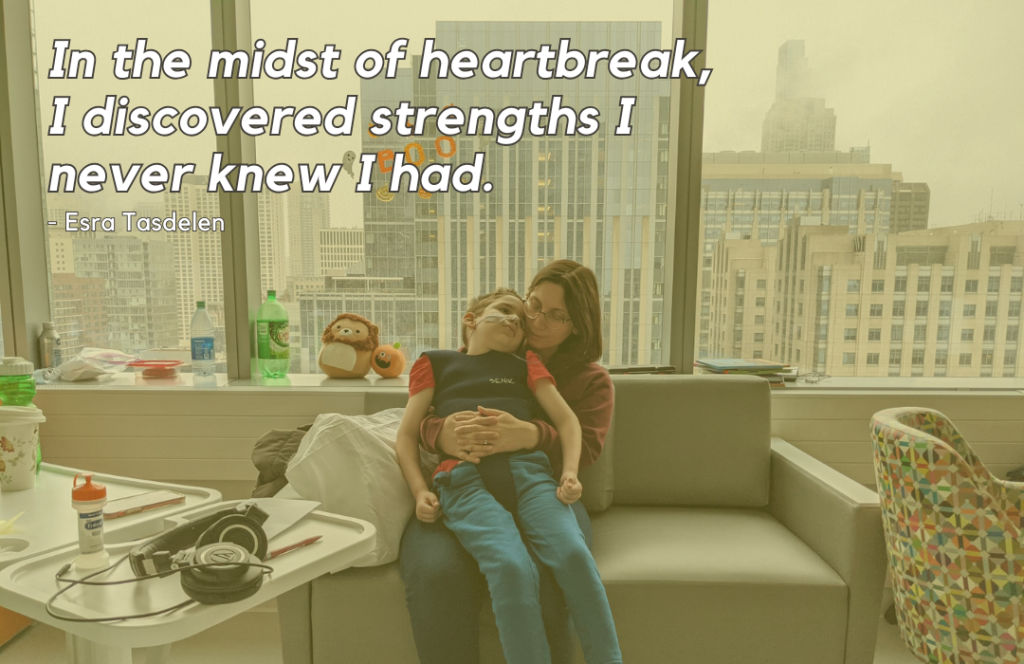
Life while parenting a child with a rare, neurodegenerative disease through the pandemic was challenging, but still felt somewhat stable, as long as we could protect my son from viruses throughout the lockdown and the post-Covid world. However, everything changed in August 2022 when Covid-19 finally struck, triggering a metabolic stroke and intubation for two days. In those moments, life unraveled completely, and the virus took more from us than we ever thought possible.
Every day is a balancing act, with caregiving woven into every moment.
My son lost his ability to walk, talk, eat, and use the bathroom independently. At 10 years old, he is now nonverbal, dependent on a g-tube for nutrition, and requires constant, complex care—several hours of therapy and countless medical appointments each week. Caring for my son is a continuous, around-the-clock responsibility, 24 hours a day, seven days a week, without pause.
It has now been over 26 months since I last heard his voice. The seasons have changed, but the grief remains a steady tide that never fully recedes. I’ve learned to live with it, though it still washes over me in waves. Sometimes the tide is low; other times, it crashes down, threatening to pull me under.
Grief changes you. It hollows you out from the inside, replacing hope with bitterness.
It introduces you to parts of yourself you didn’t know existed. When everything goes wrong, you meet a version of yourself that you never expected. It’s easy to stay cheerful, maintain a positive outlook, uphold principles, follow motivational quotes, or adopt a holier-than-thou attitude when life is running smoothly and everything is going your way. But it’s when everything falls apart that you come face-to-face with parts of yourself you never knew existed.
The pandemic only deepened my bitterness. I remember parents at my son’s school brushing off Covid as “just the flu,” their indifference cutting deeper than any insult. I watched as others wrote letters demanding schools “unmask our children,” as if the lives of the immunocompromised, like my son, were expendable.
It became painfully clear that many people prioritized convenience over the lives of the vulnerable. I saw unsettling echoes of survival-of-the-fittest thinking emerge: a blatant dismissal of those with genetic conditions, disabilities, or rare diseases as though their lives were somehow less valuable. A mask, nothing more than a small inconvenience, became a political battleground. Ironically, the children seemed fine wearing them while their parents protested.
When the masks finally came off, my worst fears were realized. It took only three days for my son to fall critically ill and end up back in the hospital. Everything I had feared came crashing down, and the weight of it still haunts me. Some nights, I wake with bitter tears in my eyes, unable to escape the memories. J’accuse!
Grief is relentless. It creeps in, twists your thoughts, and reshapes you into someone you barely recognize.
I catch myself sometimes, watching healthy children my son’s age running, laughing, playing as if they are entitled to carefree joy. And in those moments, dark thoughts bubble to the surface. I ask questions I never thought I would: Why them? Why not my son? I wrestle with anger, even at God, aching for answers that will never come.
Summer is always the hardest. Social media becomes a parade of families doing fun things outside with their healthy children, a constant reminder of everything we lost. It feels unbearable at times, like standing outside looking through a window at a life we can no longer touch.
It is the fall of 2024 now and it has been more than two years since our world turned upside down. Life from that time feels like it belongs to someone else, lifetimes away from where we are now. Yet the grief remains, relentless as the waves lapping against my shore. I can’t stop it or fight it. Instead, I have learned to move with it, hoping that when the tide recedes, it leaves behind small treasures in the sand, enough to make life bearable and worth fighting for.
I’ve learned to bend with the pain so it doesn’t break me.
Each day requires finding the strength to keep breathing, no matter how heavy it feels, and placing one foot in front of the other. I’ve discovered that survival means focusing only on the day at hand, facing it moment by moment, because looking too far ahead can be overwhelming. It’s about embracing small victories, knowing that just getting through today is enough.
I wish I could tell you that time heals all wounds, but it doesn’t. The grief still sweeps over me with the same intensity, catching me off guard. The smallest detail can be a trigger: a familiar smell, a haunting sound, a passing memory. And before I know it, I’m crying again.
People say I must be stronger now, but I’m not. There is no glory in suffering, no grand lesson to be learned. Pain doesn’t make you noble or fierce—it just leaves you standing. Most days, I don’t feel like Wonder Woman or any kind of superhero. I feel more like a cockroach, battered and somehow still alive. Kafka’s Metamorphosis describes it perfectly: the unsettling truth of surviving a disaster and still going on, even when it makes no sense.
I could tell you about how I now hate Navy Pier and even the sunrises over Lake Michigan, because that’s all we saw from our hospital window for six long weeks. How the sight of Potbelly’s sandwiches fills me with dread because it was the only non-hospital food available during those endless days. I understand now what it feels like to have blood drain from your body, because I physically felt it when I learned what had happened to my son. I’ve screamed at God and cursed Him, and I don’t even judge myself for it.
And yet, somehow, it was the small moments that saved me. Literature saved me. Anne of Green Gables saved me. The tiny Barbara’s Bookstore in downtown Chicago saved me. A tea kettle and a cup of Earl Grey saved me.
The kindness of others became a lifeline.
Messages from family and friends wrapped around me like a warm blanket, offering a little relief from the cold. One day, when I walked to Trader Joe’s near the hospital, the cashier asked the usual, “Do you have anything fun planned for tonight?” Tears filled my eyes as I told him I was heading back to my son’s hospital room. Without hesitation, he ran to the flower section and handed me a bouquet, saying, “I’m sorry. So sorry.” I thought of Tennessee Williams’ words: “I have always depended on the kindness of strangers.”
Days blurred into nights, nights melted into days, and through it all, I felt despair like I had never known before. The pain and grief hasn’t gone away—it never will. You just learn to live with it, because you have to.
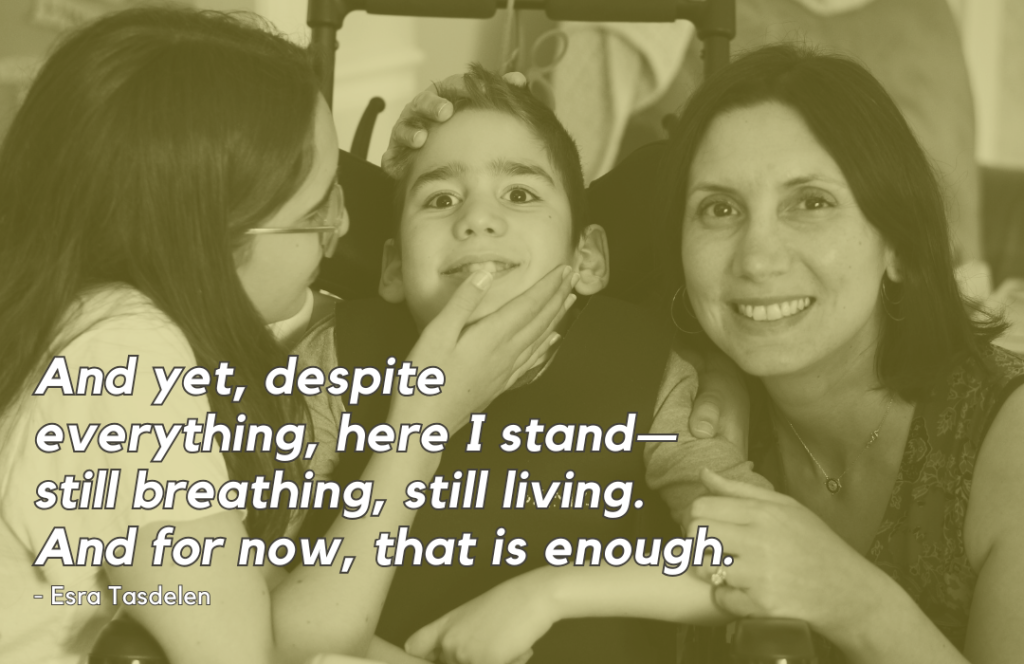
And yet, despite everything, here I stand—still breathing, still living. And for now, that is enough.
About the Author
Esra Tasdelen is an academic, writer, and mother of two, living in Naperville, Illinois. As the parent of a child with complex medical needs, she navigates a world of caregiving with resilience, love, and advocacy. Passionate about disability rights, Esra channels her experiences into raising awareness and fostering inclusion. She is currently working on her memoir, a heartfelt exploration of her journey as a mother, capturing the challenges, growth, and insights gained while caring for a child with complex medical needs.
