
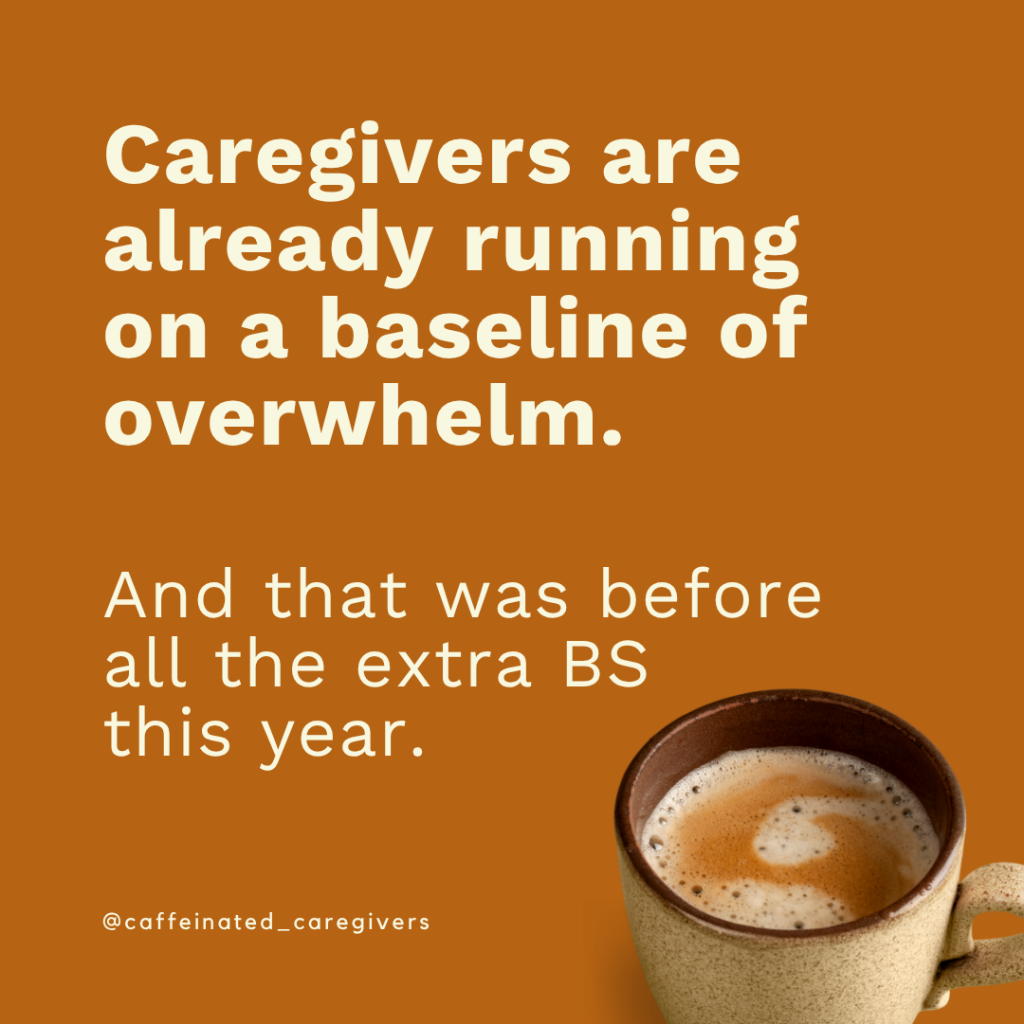
We’re back with coffee, chaos, and maybe a few choice words, and diving straight into what feels like the collective caregiver mood of 2025: utter overwhelm.
Between policy threats, service cuts, and the general sense that the ground keeps shifting beneath us, it’s no wonder so many caregivers are running on fumes. In this episode, we unpack what that overwhelm actually feels like, share some of the most painfully relatable community responses, and talk about how we keep showing up when it feels like everything’s falling apart.
From the constant fear of losing supports, to finding small acts of resistance through joy, to figuring out how to rest without checking out completely, this one’s for every caregiver who’s ever wondered how they are going to make it through, while knowing they can’t give up either.
In this episode:
[00:00:00] A chaotic reunion (and a questionable tea choice)
[00:04:00] The baseline overwhelm of medically complex caregiving
[00:10:00] What 200+ caregivers told us about feeling uneasy in 2025
[00:12:00] The most painfully accurate metaphors for overwhelm (eggs, hailstorms, and dumpster fires)
[00:18:00] How the math on policy “reforms” isn’t mathing, and why that matters
[00:20:00] Joy and disengagement as small acts of resistance
[00:27:00] Finding your people, protecting your energy, and knowing when to step back
[00:33:00] Why re-emerging matters, and what it means to not let the overwhelm win
Links:
Follow us on Instagram for research, validation, and a lot of memes @caffeinated_caregivers.
And if you have a sec, leave us a rating and review on Apple or Spotify! Thanks friends! Talk soon!
Finally get the support you need as a caregiver, right in your inbox:
Transcript:
Erica: [00:00:00] We haven’t done this in so long. I’m nervous. Why am I nervous?
Alyssa: There’s gonna be a lot of swearing in this episode too, and some of it’s from Erica and I. Some of it’s just reading your responses directly.
Erica: Hello and welcome to Caffeinated Caregivers, where we have coffee dates and conversations about all things related to caregiving. If you’re new here, I’m Erica. I’m Alyssa, and we have some stuff to cover today.
Alyssa: Okay. But, but. Before we get there, Erica, what are you drinking today?
Erica: It’s been so long that I almost forgot to mention that.
Alyssa, you’re not gonna like this. Did you bring tea to this meeting again? I brought tea to this party.
Alyssa: Oh, you brought a [00:01:00] Christmas mug. You brought tea in a Christmas. Erica, it’s October.
Erica: I’m not right. I there, listen, I claim no sanity at this point and, and this is a perfect example of that. So heck will me, I deserve it.
Uh, what kind of
Alyssa: tea?
Erica: English, breakfast, of course, because it feels fitting for the moment.
Alyssa: Well, I am an hour later in the day than where you are. Not quite noon where you are right now, but I refilled my coffee. I got probably 18 ounces of coffee in here. It’s pumpkin cold brew, which is seasonally appropriate.
I would like to add with, um. I am not over that yet. Pumpkin, cold brew. And it’s got caramel macchiato, cream creamer in it. Exactly. Two and a half tablespoons for like 18 ounces of coffee.
Erica: Okay. But I feel like I should be concerned, for those of you listening, we’ve been on a bit of a [00:02:00] hiatus when it comes to recording.
We have been struggling, but I got a sail. Didn’t realize it was that bad for you. Okay, fair. ’cause the last time we recorded you were full fledged water after like 10:00 AM like you were not going back to caffeine. You’re at almost one and you are back to caffeine. I am concerned.
Speaker 3: Yeah. I gave that up
Alyssa: a little while ago.
I am trying to be done with my caffeine by like two now.
Erica: I like how the bar has been moved.
Alyssa: It’s been moved.
Speaker 3: It’s
Alyssa: been moved to
Speaker 3: fit the season of life that we are in,
Alyssa: which is. Getting better, but probably soon to get worse. Well, I mean, not necessarily worse, uh, more chaotic for in the short term as we introduce a small puppy into our household.
Mm. And then eventually my husband returns to a teaching schedule from his sabbatical, and I am just writing it out at this point. Just going [00:03:00] with the flow. I will say, I realized I was talking to him, my husband last night actually, and I was like, well, at this point in the fall last year, Gemma and I were already like two weeks into our two month long respiratory illness that both of us had to have like steroids and other stuff to eventually get rid of and it was awful.
So. We’re doing better than last year actually. See,
Erica: I don’t mean to be superstitious, but I feel like you should knock on wood,
Alyssa: I’ve been knocking on wood every time I say that. Yeah, every time I say that. So,
Erica: well really, this is fitting for the topic that we’re gonna cover today, which is drum roll please.
Alyssa, you gotta join me on. Alright, caregivers are bleeping, overwhelmed. Yeah, we’re overwhelmed. It turns out I’m not the only one that’s overwhelmed. You’re not the only one that’s overwhelmed. There’s a whole [00:04:00] heck of a lot of us who are feeling like they are in the season of overwhelm and many of us don’t really see an A light at the end of the tunnel with this and naturally caffeinated caregivers seeing this theme kind of showing up online, showing up in our personal conversations, showing up in our group chats.
We knew we had to talk about this.
Alyssa: I wanna be realistic here.
Erica: Oh, Alyssa.
Alyssa: I know, I know, but I don’t wanna be like too negative. I think there’s a lot of truth to the whole, like we don’t see a light at the end of the tunnel. But then the other part of me that’s like, what do they call it? The self-preservation aspect.
I do have a pretty lay strong self preservation streak. Wants to at least point out that like, okay, we are in a state of overwhelm given all the news, all the like, just general bullshit. We can bleep that again, or we can not, I don’t care. Keep it going on in the world right now. All of the like constant stuff that we’re having to deal with on top of [00:05:00] like the normal stuff, which is like now that it’s flu season, it’s cold season, we’re in the midst of like holidays and family stuff and whatever.
It’s probably not the overwhelm from all of that stuff gonna lessen anytime soon. Mm-hmm. Mm-hmm. How do we get through it? How do we survive? And so we’re gonna talk about both aspects. Today. We’re gonna talk about the overwhelm part, and then we’re also gonna talk about the how do we survive it and how do we keep going Because like if this isn’t a temporary, one week, two week, one month, even one year thing.
We’re gonna have to get through it and how are we gonna do that?
Erica: It’s important to set the stage too, that like medically complex caregivers are operating like with a constant baseline rollercoaster of overwhelm, right? And, and we hear this so many times from caregivers who feel like they’re just waiting for the other shoe to drop.
And that alone comes with this just kind of. Background buzz noise of overwhelm for many families and parents in this [00:06:00] community. So knowing that that exists and it’s, it’s not what a lot of people live with to the degree that we do, and then piling on other things that are happening not only in our personal lives, add the illness, add the shoe dropping, and the stuff that’s happening at a societal level.
I would say that it feels like a understatement when I use the word overwhelmed, because I don’t know about you, but I have definitely breached the point of just fearful,
Alyssa: well, we’ve talked before about this idea of caregivers to feel like, okay, not even like great, not even perfect, but just okay and stable in their lives.
Right. They need a certain number of supports and things propping up their life, right? So we’ve got things coming from different angles, right? But like Medicaid probably for their kid. Whatever supports they get for that, educational opportunities for their kid, maybe like community support of some kind.
Maybe it’s nursing, [00:07:00] like the collection of things that they need. Could potentially look different from caregiver to caregiver, but there’s all these different aspects. The basic ability to like make sure their kid gets their specialized diet or whatever, or they’re hard to manufacture medication. All of these things.
There’s all these like little pieces propping up this platform that is caregivers and their families, and when you start kicking out sticks underneath that platform, it doesn’t take very long before the things start to like crumble down or whatever. I think for caregivers too, a lot of times we can lose.
Not very many of those sticks before it starts to get pretty bad.
Erica: Straight up unstable,
Alyssa: straight up unstable. And then like you get to the time period that we are right now where there’s information coming in from all sides about how all manner of these things could be compromised in some way or another.
It’s not even just one of them. It’s education stuff. It’s insurance stuff. It’s like insurance stuff. [00:08:00] Aside from the Medicaid aspect potentially, right? Mm-hmm. Mm-hmm. Like we’re not even talking about government supported insurance. Plans, medication, medical assistance. Yeah, we’re
Erica: talking premiums. We’re
Alyssa: talking, yeah.
That kind of stuff. Although we also are talking about Medicaid and government assistance and then all these other things, you know? Yes
Erica: we are.
Alyssa: There’s all this stuff congealing together and it’s like, well, you start to feel threatened on all angles. It’s coming in from all directions, and that’s a lot to process and it’s a lot to like, you know, how do you formulate a plan?
All of these things could be compromised in different ways. I understand it. And to your point, like overwhelm does seem insufficient for what we’re feeling.
Erica: Honestly, when you said threatened, I had like a physiological response to that. My body immediately identified with that. Mm-hmm. Descriptive word, and then I was like, oh.
That makes sense because I’m [00:09:00] building defenses. Mm-hmm. Like I’m constantly on the defense right now in my existence as a caregiver because I feel constantly threatened. Wow. Thank you for, you are welcome pointing
Alyssa: that out for the terrible terminology. Yeah, but that’s avie. That’s avie. So it is. Again, we are not the only people feeling this way, and also we’re not the only people with some very descriptive and poetic language about how they’re feeling.
So true
Erica: story. Let’s talk about it. Yeah. We pulled our community to really get a pulse on how everyone else was feeling, and we did ask very specifically, are you feeling an increase in overwhelm and unease?
Alyssa: I have one note on this. We asked this poll before the government shut down. Also,
Erica: just that, oh, that is a very important note to take into consideration, and we had over 200 people respond to that [00:10:00] poll, 81%, a total of 193 people out of what almost 240 said.
Yep, definitely, definitely feeling overwhelmed and. We had about 36 who kind of said kind of, but not all the time. And then we had about 3% who said, I don’t feel this very often, and 1% who say, Nope, don’t feel this at all.
Alyssa: I think that was literally like three people.
Erica: Yeah. Yeah. I don’t know at this point in time, if I envy those three people.
Or if I’m concerned about those three people, but that’s a conversation for a different time.
Speaker 3: Maybe they don’t live in the US or watch like international news.
Erica: That is what I’m hoping. That’s where I hope those three people exist, but not, we didn’t stop there because we can’t stop there. That’s not enough information.
We needed to hear it. From your words, how are you feeling? What does this feel like? Tell [00:11:00] us in your own words what this feels like.
Alyssa: We asked this, this is how caregivers feel. Living in 2025, I think was exactly how I phrased the question,
Erica: and Alyssa was not exaggerating when she said that. We had some very poetic responses.
Alyssa, if you had to name your number one top favorite response of all the ones that we got, ’cause we’re gonna name a few, but I’m just curious, which one was your favorite?
Alyssa: Oh, okay. By far. This one’s down at the bottom here. Actually, no, there’s two of them. I’ll read ’em both together. There’s gonna be a lot of swearing in this episode too, and some of it’s from Erica and I.
Some of it’s just reading your responses directly. So the first one says. It feels like others were juggling balls and we got eggs instead, and the ground is shaky and now they’re throwing the eggs at us. And then my second favorite one just says, I waffle between we’re fucked and we can do hard things.[00:12:00]
Erica: Nailed it.
Alyssa: Yeah,
Erica: nailed it with
Alyssa: that. I also feel that way. That one probably most describes my perspective right now. Which one’s your favorite?
Erica: Yeah. Living in a specific part of the United States. The one that like really resonated with me as something like, I was like, Ooh. Yeah. Felt that was the one that said, standing in a dumpster fire with a squirt gun while everyone else is making s’mores.
That’s what it feels like
Speaker 3: every day, every day. That was another one of my favorites.
Erica: There’s so many. I think we should just read them because there’s a lot of good ones. I think the other one that it was just real and it like really hit me at the core, it was pitied instead of helped. Pressured instead of given grace, ignored instead of heard.
For me that just hit all the things.
Alyssa: And one of the ones that kind of like sums up what we were talking about earlier too, is everything is harder now and it was hard to begin [00:13:00] with.
Erica: Mm-hmm. A funny one that also resonated that you and I both really enjoyed was like an umbrella and a hailstorm. I love that one.
Probably right now it’s feeling more like a typhoon mixed with hail, right? Mm-hmm.
Speaker 3: Yeah.
Erica: And then other two, I think that really spoke to some of the underlying pain that we live with before we’re overwhelmed, and then how some of that overwhelm highlights the pain that we feel as caregivers. And so I’m gonna read two that really spoke to that, in my opinion.
The first one said. It’s exhausting. We feel invisible, worn down, and like it’s impossible to stay afloat. And I, I feel like oftentimes, even without the current events being what they are, I feel like that,
Alyssa: yeah. But
Erica: then someone else, a wrote peaks of improvement followed by decompensation and feeling like those peaks were actually a betrayal.[00:14:00]
Mm-hmm. And I don’t know how many times. I have felt like that as a caregiver too. Like, oh, we had a good week last week. There was no bad news. And then it’s like the next week everything happens at once and I feel like I’m paying for it.
Alyssa: Yeah. There’s also that aspect too, and I’ve been seeing more of this, honestly, I think my household is kind of doing the same thing where the last few years, a variety of states did implement like more waivers, more options, more services for families with medical complexities.
There’s just a lot of uncertainty about whether or not that’s going to continue, how long those are gonna be available. If you’re on them now, will you get to keep them? If you’re not on them now for whatever reason, you’re in the process of qualifying or you know, you’re, you don’t qualify yet, but you will soon, like, will that option still be open to you?
I mean, we’re trying to get Gemma on a new waiver to get her some pretty basic stuff that she needs. And I’m like, I don’t know how long this process is gonna [00:15:00] take. And I don’t know, there’s like different points that when certain funding changes kick in or don’t. And it’s like, when those kick in, how’s that gonna affect, you know, whatever services she has, like under these waivers.
Right? And like, can we get the waiver now, get the things that we need so at least like if we lose it later, we’ll have some of this like basic stuff covered, like all those kind of questions too, where. Yeah, maybe you can have this improvement for a minute in your life, but you’re not gonna get to keep it.
Or maybe you will get to keep it, but you’re not sure and like how do you plan amidst all the uncertainty. I mean, you’re right. I,
Erica: that does feel like a major betrayal.
Alyssa: Yeah. I wanted to read a couple more that I really like. Okay. I think some of these like really encapsulate kind of. They’re not as specific and they’re not as colorful.
Although, don’t worry, by the time this episode comes out, you’ll have seen the Instagram post with all of our very colorful descriptions from you guys. But the one that I think like [00:16:00] really kind of, or the, the two I should say, encapsulates this just like total feeling of things, is the first one says constant worry and disbelief.
How are we moving backwards? I think that really tags onto the one that you shared, Erica, about like feeling betrayed, right? Like we got progress, we got the things, not everything, right? Like not even close to everything that we need, but we got, no, we got crus, we a little bit, we got crumbs, and then we’re not even, you know, those crumbs.
I, I should say, I suppose because there’s so much in the air we don’t know what’s gonna happen, but like those crumbs are potentially being threatened and it’s like, come on. Like come on, really? And then kind of on that. This one says stressful. I’m just worried about cuts to the programs and the overall climate against disabilities, and I think that is the other thing that I don’t think we have time to like dig into it all the way today, but there is, well, I don’t know that there’s as much broad societal empathy.
For kids like ours, for other people with disabilities, things [00:17:00] are progressing in a way that feel like they’re getting continually more individualistic and continually less supportive of any groups of people that need any sort of social support. And it, it’s not explicit. It’s just the vibe, but the vibe doesn’t feel good.
Sometimes it’s explicit, but mostly it’s not. I think. And we’ve said it before, but like the math is not math thing, right? So like if you go to any of these lawmakers and you talk to their staffers and you know, you listen to their press releases and whatever, they’ll be very explicit and they’ll be like, oh, not for your kids, not for people with disabilities.
We don’t mean any of these like cuts or changes or whatever to impact those people. That’s not who we’re trying to target. I’m not even gonna make the argument. About whether or not that’s true. I have my opinions about that. I’m sure you do too, Erica. But like that’s not actually the argument at hand.
The argument at hand is like, does the math work though? Mm-hmm. And at the end of the day, some of these proposals that are already in action, they have happened already. They just have not come fully to [00:18:00] fruition. The math is not math. The math is not working out the way that they have laid it out right now if it’s not supposed to impact our families and our kids.
And so at the end of the day. I don’t even know that like the intent even matters that much. Maybe they’re not trying to like target our kids, you know, or our families or whatever, but that’s not gonna matter because yeah, the way that some of these proposals have been set out right now, it will one way or the other, and I think this is a good time to transition into our next section, which is like, what do we do with that?
There’s a lot of stuff out of our control. There’s a lot of stuff that’s already been passed through Congress. There’s a lot of things in the budget that are already laid out. So like, man, what’s the reaction to that that you get? Are
Erica: you asking me that question?
Alyssa: Yeah. I, I am asking you that question, especially because I think you have actively engaged in this protection mechanism at points.
Erica: I have. And you know, I, I realize that we have put off recording this episode because some of these things have been really hard to [00:19:00] articulate honestly, for months. Mm-hmm. Feeling overwhelmed is not new.
Speaker 3: Yeah.
Erica: So. Talking about what do we do is so hard because I am still trying to figure that out. I am trying to survive, trying to just get by, get through work, get through my day, get know, enjoy my time with my family, enjoy life as I know it.
With friends, with the freedoms, we have to still gather. Still make art music to read, to listen, but it’s still been a struggle because in all those moments, these conversations come up. The reality has not changed. We’re doing all these things with this era of fear and concern. And it’s changed how we experience joy right now.
It’s no longer, things are [00:20:00] great and they’re gonna be like this for a while. It’s more like, things are good today. Who knows what the next headline is gonna be? So let’s just enjoy this moment as is. And believe it or not, that is really hard to do. In that sense. It does feel like a little form of resistance.
To be able to feel or find joy in this moment where there’s so many things to be fearful of. It’s not easy. I think it’s very important to also acknowledge that I see that as a female in a white body. I. I cannot even imagine what life is like right now for my friends and my family members and the people that I don’t know and have no relationship to that are black or brown or just non-white.
I’m in a position where I hear from and I pay attention to, to the stories that are being shared from that community. There are caregivers that are concerned about whether or [00:21:00] not they should go to their child’s doctor’s appointment because. They could get pulled over, they could get stuck in traffic, they could be met at the institution itself with some sort of presence that has every intention of violating their human rights and who’s gonna take care of their children when that happens.
Alyssa: Yeah.
Erica: And we are mildly, we, we are not off topic. These are the things that keep me up at night, but um, it’s a reality probably for some of the people who are listening right now. And I think that we have to acknowledge that. And so when you ask me what do we do? How do we protect ourselves, even in the short term, where do we go from here?
It’s fair to say it’s, it’s a really hard thing for both Alyssa and I to answer because every individual person and family is going to have their own unique way of working through this and surviving and thriving through this.
Alyssa: Coming back to like the immediate response though. In the immediate [00:22:00] moment in the day today, you were constantly being bombarded by like terrible stories, bad news, upsetting things that we’re hearing and seeing and whatever on the news and social media and all of that, and potentially even conversations with our family.
But hopefully those are things that you could potentially reroute. One thing that I think I have seen more and more caregivers. Do, and I think it’s very powerful. And again, getting back to you, Erica, I think you’ve utilized this in certain ways, is to be able to like disengage from some of that bad news.
In the moment at least you read something that’s just like super upsetting and you have that moment where you’re like, okay, I would like to put my phone. Down and walk away and not open up these apps and not read these headlines and not get the email for like a little bit. And I think this one hits particularly hard for me because in my Joby job, a lot of what I do is running social media and keeping track of things and like doing a fair amount of like digital news and content work.
For other [00:23:00] clients. And I have had multiple times this year where all I wanted to do is put my phone down and walk away for a couple hours and not look at any of it. And I suppose I could have done that, but I don’t think it would be beneficial to my work relationships long term to do that. But I think about that and like in the moment when you’re starting to get like right now and it’s very second like overwhelmed.
I think a lot of us have this impulse to just like step away for a second, and I think that’s okay. I think that that’s actually really necessary in the short term.
Erica: I do too. Yeah, I think it is. A tactic that is helpful not only for you in the moment, but also potentially for the people surrounding you too, because I’m not sure about you, Alyssa, but when I do start seeing the headlines, when I log in, when I get online, when I am even just listening to someone else, share a story, because for my Joby job, I, I do like, I hear stories [00:24:00] all day long by nature of just my work alone.
Disengaging is not always an option. So kind of taking into account how that engagement affects me is, has been a big way of making myself feel okay and giving myself permission to turn everything off and saying, not to just myself, but to my family. Okay, this is US time. Now I’m gonna make the bread, I’m gonna.
Clean the house. I’m going to read the books to you. I’m gonna watch the movie with you and turn the rest off. Because at the end of the day, those are the moments that matter the most. I cannot be in this space or be me without those moments anchoring me, you know? So yeah, disengagement as a protective tool and using that tool to protect our energy, even if it is for the short term, because let’s face it.
An hour and a half to two [00:25:00] hours my goodbye and what am I finding myself doing, logging back in?
Alyssa: Well, the other end of that too is I think we’ve both kind of hit on this now, is like, it’s not a long-term strategy right now. I should note here that. Disengagement and engagement. Those don’t necessarily mean like you’re on social media scrolling Instagram or you’re not on social media scrolling Instagram.
I mean, those are definitely ways that we engage and disengage, but like when we talk about like, what does engagement mean long term? It doesn’t necessarily mean spending six hours a day on social media, so I wanna be clear there. Or spending six hours a day scrolling through news or like watching news or whatever.
Whatever that looks like. It doesn’t necessarily mean consuming content or not. But at the end of the day, I think staying out of things, removing yourself like fully from like awareness about what’s going on, what’s happening in Congress, like what is happening like at a national level and a federal level and a state level, that actually in the long [00:26:00] term, I don’t think gets us where we wanna go.
I don’t. Say that because I even necessarily like think that’s like the healthiest. I mean, I would love to just like settle this stuff aside and not ever have to worry about it again. I think for me individually as a human person, that would probably be the best option for my mental health. I think the problem is that kind of, as we’ve talked about earlier, we didn’t say it directly this episode, but I think we sort of got around to this like, who else is out here for the most part?
Advocating for our kids. Mm-hmm. I don’t wanna say that only caregivers and parents of medically complex kids are advocating for our kids. That’s not what I mean. By that. I do mean that the cohort of people advocating for them is very small, and without us it’s even smaller. So if we stay out, if we aren’t getting engaged at a certain point, then like who’s out here defending our families?
Yeah.
Erica: So thinking about how do we come back from this? [00:27:00] How do we come back from feeling overwhelmed and the paralyzation that comes with that? Some steps, even though we don’t wanna be prescriptive, I think what I hear is recover first. Don’t reengage. Don’t feel like you have to do anything. Don’t put that pressure on yourself until you’re ready.
Recognize where you are in the caregiver continuum, which if you’re not familiar with that term, we have a whole episode dedicated to it,
Alyssa: A whole episode and a whole lot of. Written stuff about it now too. Yeah.
Erica: You know, so if you’re in survival mode and you’re coming outta that burnout, so most of us who are feeling intense, overwhelm and paralyzation, you’re probably in some form of survival.
That mode. Whether you’re able to recognize that or not, you know, wait maybe until you’re out of that to start reengaging. There’s other things to prioritize, including yourself and your wellbeing while you’re in survival mode. So don’t worry [00:28:00] about the kind of big a advocacy. Also let other people take that role.
I can’t tell you how many times, especially in the last couple of months when I’ve been going through something personal, it was really comforting to me to see that I didn’t have to be out there saying anything. I have surrounded myself with a community of other caregivers and advocates, and it gave me a lot of peace of mind to see that even when I couldn’t engage, there were other people who were.
So that kind of brings us to like stepping back in. If you don’t already have a community, start finding that because there’s no way that any of us can do this alone. If there’s one thing this moment is teaching me or reinforcing in me, it’s that it does take a community. We don’t have to be a huge community, but even just having people that you know you can trust and that are [00:29:00] doing similar work and have similar values.
That can make a big difference.
Alyssa: Yeah. And then also coming back to kind of what I said earlier about like reengaging, it doesn’t necessarily have to look like going back to exactly however you were engaging before, right? Like mm-hmm. There is a certain point where there’s so much information coming at us all the time.
There’s so many headlines, there’s so many things going on in the world, and that is by design. One thing that has been really helpful for me to develop is like the skill to filter and prioritize information.
Speaker 4: Mm-hmm.
Alyssa: And again, I don’t necessarily have a prescription for how exactly that information gets filtered and organized.
I do think it sort of depends on your situation, but the fact of the matter is, is that we cannot be worried about everything in the world all the time. We’re one human with a limited amount of capacity and power, and we’re also caring for children and our [00:30:00] families and, you know, worrying about medical conditions and all of that.
We do not have the energy to take on every single thing in the world. But that doesn’t mean that we can’t have our things that we stay engaged with, that we work on that like we do worry about. And again, what those things are. That’s kind of up to you to determine. But having that like filter that’s like, listen, I see this and I get it and it’s bad, but like I, after reading the headline, don’t have the energy to engage with this any further.
That’s okay. Actually that’s like really important. You have to do that somewhere. Someone else is probably gonna pick a different thread to be engaged with or worried about or whatever. And the fact that like we can have people crossing over on all these different things and like spending their energy on like.
Two or three issues is probably gonna be much more effective than all of us being paralyzed because there’s just so much.
Erica: Mm-hmm. One of the ways that I find [00:31:00] myself filtering is just honestly recognizing what I do and do not have control of. That’s like a therapeutic technique that I definitely learned from one of my therapists.
But it’s a very helpful one because sometimes I need that reminder that like I, you know, at first as a caregiver, it, it was very much specific to my child’s diagnoses and what I could do as their caregiver to support them and what I couldn’t do. And then it was about illness, what I could control when I came to my children getting sick and potentially being hospitalized to what I can’t control with that.
That circle of control mindset, it has applied to so many aspects of caregiving. Then naturally, I found that it applied to this as well, which is, it doesn’t mean that I have to say I remove myself. I am absolved of caring about this. It just means in this moment I have a diaper change, meds to be made, an appointment to reschedule.
Those things I [00:32:00] can control. I need to focus on those right now, and when I have the capacity, the energy, and the emotional strength to look at what else is happening beyond our door, beyond our own home, I will do that.
Alyssa: No, I think that’s super important because it gets at that thing where like you’re gonna have ups and downs.
You’re gonna have moments where you can do more things and you can be more engaged, and you can call your senators and you can write your letters and you can engage your community, and you’re gonna have moments where you can’t do any of that. And the point of this episode, I think is not how much are you doing every single day or not doing or feeling overwhelmed or whatever.
I think the point is in the long run, we can’t let the overwhelm win, like we don’t have the option. To let the overwhelm beat us all down, all at the same time. Like if everyone feels like it’s too much, like we’re never gonna make progress, we’re never gonna have enough power to [00:33:00] make the changes that we need, then we won’t.
Like, I mean, just functionally we won’t, right? So we can’t let that be the end result of all of this. But again, in the day to day. You gotta think about like, okay, what’s gonna like get me to that end result of like not giving up basically. And it might be taking lots of breaks and taking steps back and protecting your energy and just protecting your family because keeping our kids alive and healthy in all of this, in and of itself is its own little fight back.
Erica: Yeah. I mean, I think it’s. Especially important to also consider this is not new. What, what is happening in, in some ways has happened in the past. And we can look to the past to see how communities made it through. How did they band together?
Alyssa: Well, we’re not the first one. This isn’t the worst time in history, as bad as it [00:34:00] seems to be disabled, which is an amazing thing to say, but I think that kind of like shows the arc, right?
Things go up and down. But in historically, we have made a lot of progress in disability rights, and I think it wasn’t always like everyone fighting for it, it was a small group of like dedicated people that was able to make those impacts. Right? Like. We don’t have to make, we don’t have to get every single person on our side,
Erica: and there were allies there too.
One thing we’ll be talking about in some upcoming content and, and just throughout the future of caffeinated caregivers, like recognizing who our allies are in this too, whether that be people in your immediate community or cul-de-sac or block or family or friends. There’s also other people working behind the scenes.
We are seeing really come out and, and speak out on these issues. I don’t know about you Alyssa, but like one thing that has helped me combat the overwhelm is seeing people who I have like been friends with for a while who I, [00:35:00] I know I’ve educated in some way and I can see that because. They’re resharing content about Medicaid.
They’re, they’re taking the initiative to start educating their friends and peers and they don’t have quite the same stake in it as I do. So even in the overwhelm, look for small signs of your work shining through, you know, of your advocacy having an impact. Because I think that’s the other piece of this is that even if it’s not the big impact that we hope to see at a policy systemic level.
I think there are small seeds that all of us have been planting, and that’s why it’s important when you’re ready to continue planting those seeds because reemerging is resistance.
Alyssa: It really is just not giving up. On the things that our kids need, the things that our families need, the things that disabled individuals of all racist classes, whatever deserve just not [00:36:00] giving up on that is its own form of resistance.
Taking breaks, but not giving up. Is what’s gonna get us through all of this. And we’re at a tricky time. You know, like I understand that some of these conversations that we may have to have some of these things that we may be seen saying publicly. They can make some people really uncomfortable and they can make people feel unsafe.
And again, I don’t wanna make the determination for anyone about whether or not you are in the position to be able to make those statements or make those calls or whatever. But I do wanna say one thing generally, which is that. At any point in history, at any time, under any government, in any society where advocating for something that you need that doesn’t exist, that is around human rights will be risk free.
Mm-hmm. It’s never risk free. It’s always risky. To some degree and degrees vary, but like it’s always risky to take the position that’s not entrenched in society at any given time. And so calculating your risk for like what can [00:37:00] you handle, what can you say, what feels safe for your family, that’s something that like everyone has to determine.
But at the end of the day, none of us can do this work with any guarantee that there will never be a consequence from it, unfortunately. And I wish that that was not the truth, but. I also am a big fan of history, but also as being a big fan of history. I’m going to butcher this. Martin Luther King quote, and I know that it’s very stereotypical to say it, but I like this one because I do think it’s true.
And that’s the whole idea of like the long arc of history bends toward justice. And I think if you look at the long arc of history, that’s true. Things go up, things go down. But in general, we’ve made progress on human rights. We’ve made progress on human rights in the last 50 years, a hundred years, 10 years, even on disability rights.
And if we lose ground now. I do truly believe that it’s temporary and that we can come back from that and we can fight back from that. Mm-hmm.
Erica: We started this [00:38:00] episode with talking about overwhelmed, and it’s not lost on me that out of roughly 240 something people, 200 of you said, yep. I’m overwhelmed.
That just says a lot. So if anything, as we’ve talked today, if you were one of those 200 or the others that maybe didn’t get the chance to fill out that poll but would’ve answered that way, I think it’s important to know that you’re just not alone in that we are here with you in that feeling, and we will continue to try to find language and ways to help you work through it.
But the fact that you’re here listening to this tells me. You are finding small ways to work through the overwhelm, and for that, I’m proud of you and I really hope this didn’t further overwhelm me.
Alyssa: I hope that it didn’t, sometimes reality is overwhelming, I guess, at the end of the day. And I also wanna acknowledge too, that like it’s not fair.
Like many things that come along with this life, it’s not fair that we get shouldered with so much. It’s not fair that we [00:39:00] get shouldered with caring for our kids and keeping them alive, and then also like fighting for their human rights and then also having to shoulder some of the work of like trying to change society for the better.
For all these things too. Like it’s not fair. We should have more allies. We should have more support. And I think it’s okay to like acknowledge and feel in this overwhelmed this, I should note that like we did anchor the question, are you feeling more uneasy or more overwhelmed at this point? Like specifically around 2025?
So maybe some of you are not that your baseline is just like it’s already too much, but like we also know that there’s a lot of you that are like, no, it’s more too much now. And if you need that moment to be like, this sucks and it’s just not fair that we have to do all of this. Take your moment. Take your moment while you disengage to like feel that, like you deserve that.
Erica: Take it with coffee, take it with tea. Yeah. Alyssa won’t be there to heckle you if you do it with tea. I promise.
Alyssa: It’s true. It’s just me. If you want me to heckle you though, you can send me a picture of your tea and I’ll be like, Ugh, tea.
Erica: Well, [00:40:00] thank you guys for listening today. I don’t remember how we usually wrap things up, Alyssa, it’s been a while since we’ve done this.
I think we just
Alyssa: say goodbye. Oh good. We didn’t even get to acknowledge why we disappeared again for like eight months. That’s for another
Erica: day to be continued. But also may the force of caffeinated caregiving be with all of you.
Alyssa: There it is.
Erica: You found it. I did it. Alright, bye.
Alyssa: Bye.
