
Editor’s Note:
We’ve expanded on the concept of the Caregiver Continuum to provide a deeper understanding of the stages caregivers experience on their journey. For a more comprehensive exploration, we encourage you to read our full article, “Navigating the Caregiver Continuum: From Diagnosis to Advocacy,” where we dive into each stage and offer valuable insights for both caregivers and professionals.
Learning to be a caregiver and navigating the advocacy that comes with it doesn’t just happen overnight. In a perfect world, we wouldn’t have to advocate for all of our needs to be met. But, since we don’t, as soon as we become caregivers to medically complex kids, we also become advocates for both our children and ourselves.
Advocacy, caregiving, and what our life looks like in those moments can be very different for each caregiver depending on our stage of life, how many of our basic needs are being met, and our time and resources available to spend on advocacy work. We often cycle through different levels of capacity throughout our lives as circumstances change, often on short notice.
We’re calling that cyclical process “The Caregiver Continuum.”
(Want to hear our whole podcast episode explaining the Caregiver Continuum? You can get it here!)
But, why do we even need to map out the Caregiver Continuum?
A refrain we often hear from caregivers is, “Well my life isn’t as intense anymore, so I feel guilty asking for more support or more action from society.” But here’s the thing: whether or not a caregiver finds themselves in an intense period of caregiver RIGHT NOW, they will likely find themselves in an intense period of caregiver again in the future.
And just because your life is slightly calmer doesn’t mean that caregivers—who are often carrying the weight of society on their backs through their tireless unpaid labor—don’t need or deserve more support than we get. We’re often just conditioned not to ask for it.
Another reason is that caregivers should understand that at any point in the Caregiver Continuum, they are advocates and doing advocacy work. It just looks different in each phase of the continuum. Throughout our lives as advocates and caregivers, most of us will be traveling up and down the continuum, depending on how many of our needs are covered and what feels manageable in our lives at a given time.
Some of us may never have the time or energy to be our own advocates, and that is okay! When it comes to advocacy, we want to validate every single one of you. No matter where you are on this continuum, you are an advocate.
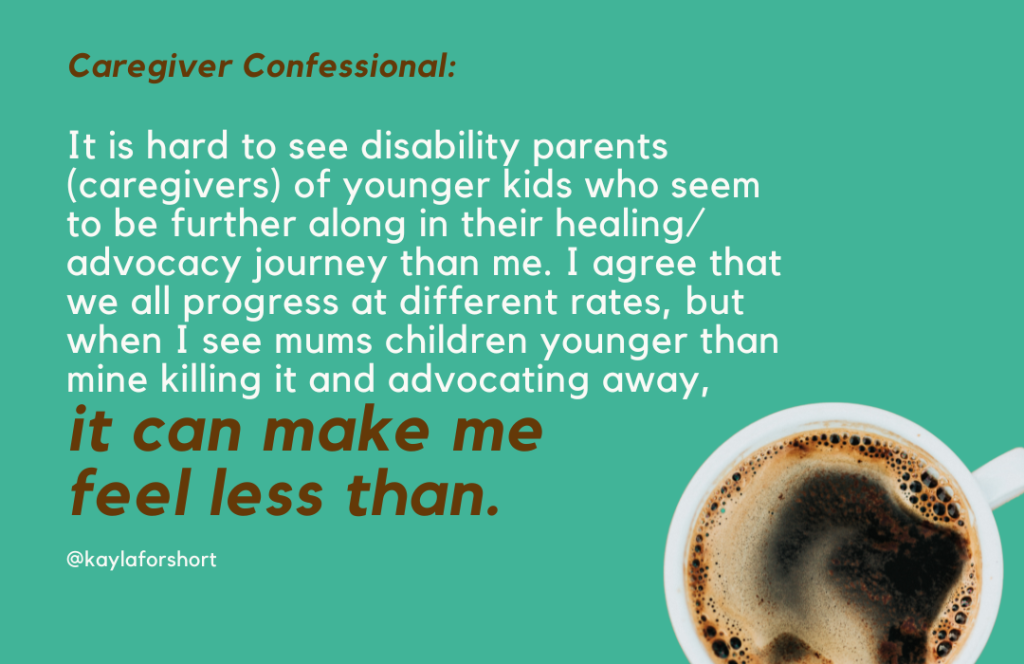
Finally, mapping out our journey allows us to both navigate our own journey, hold space, and give ourselves grace as caregivers when we can’t show up in the same capacity as others or even as we need at another point in our lives, AND have space and empathy for other caregivers who are navigating through their continuum at a different pace than ourselves.
Stage #1 of the Caregiver Continuum – The Survival Stage
Overview: This stage is characterized by learning or re-learning the basics of how to be a caregiver and flexing our advocacy muscles for our children, typically in a medical or educational setting.
When this stage occurs: This is typically the first stage we go through, often when we enter the medical system for the first time. We can also cycle back through this stage during very medically intense and traumatic times, like long illnesses or hospitalizations and times when our families lose support systems.
Advocacy in this stage: The advocacy practiced by caregivers during the survival stage includes managing medical teams, calling insurance and pharmacies, managing DMEs, scheduling appointments, navigating IEPs, and arranging our lives to best support the stability of our children among other things. More time-consuming versions of advocacy for our children may include requesting a second opinion, appealing an insurance denial, taking your child to the ER and refusing to leave, requesting an IEP meeting, and arranging our lives to best support the stability of our children – regardless of the opinions of those on the outside of our communities.

Stage #2 of the Caregiver Continuum – The Burnout Stage
Overview: This stage is characterized by the realization that we cannot continue in a state of survival indefinitely and have to prioritize our health as a caregiver too. Once we become more confident with advocating for our child AND have reached a place of stability with their medical needs, many of us begin to realize that our children are not the only ones in need of advocacy – we need to advocate for ourselves as well.
When this stage occurs: This stage typically follows periods of high medical intensity and hits in the “come down” periods, when we feel most exhausted and start to process the traumatic moments we’ve experienced. This often coincides with being completely burnt out, incapable of continuing the way we have been.
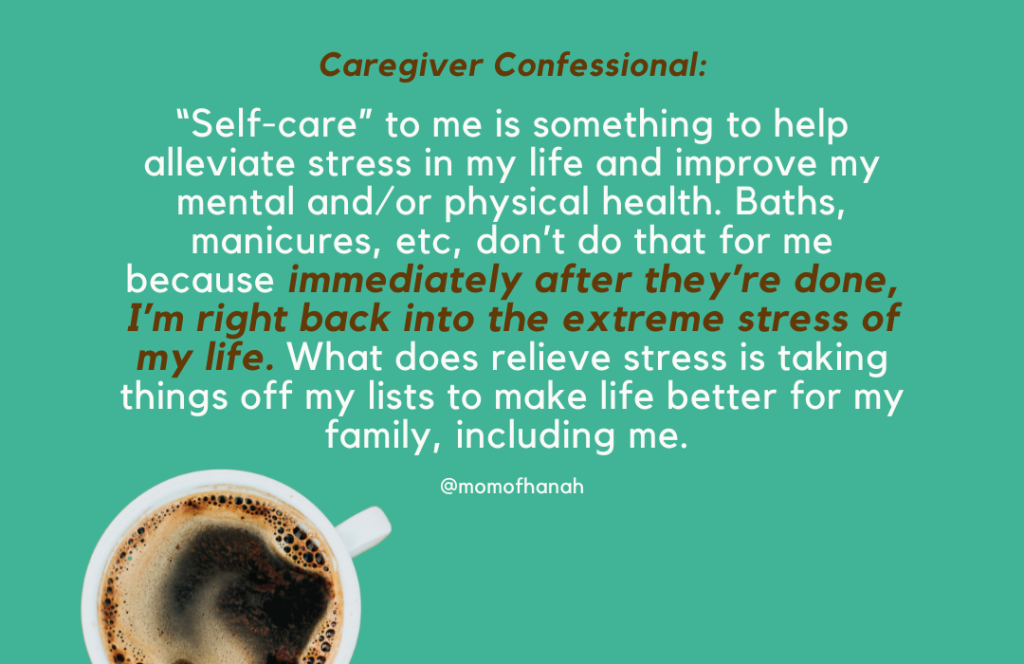
Advocacy in this stage: The advocacy demonstrated by caregivers during the burnout stage includes prioritizing our mental, emotional, and physical health, redefining self-care in a way that’s actually useful to us as caregivers, and rearranging our lives in a way that supports our whole family unit, not just our disabled and medically complex kids.
As we start advocating for ourselves as caregivers, that often means making care decisions not only for our child, but also for the needs of our entire family (for example, how many therapy sessions we can reasonably do in a week), researching and acquiring resources to support our mental health, requesting in-home nursing care or becoming a paid caregiver when available, and understanding that our well-being is necessary to be able to care for our children. We start taking time for ourselves as caregivers in big and small ways. We may also potentially recognize that advocacy can be its own form of self-care and begin taking a larger, more forceful role in that.
Stage #3 of the Caregiver Continuum – The “F%$# Around and Find Out” Stage
Overview: This stage is characterized by the understanding that change and progress require education and advocacy that is bigger than any individual or single-family unit.
When this stage occurs: This stage typically occurs after we have many of our needs met for our children and also for ourselves and in times of relative stability for our families. We begin to feel more comfortable undertaking bigger, broader advocacy projects that lead to new research or new legislation. Because of the difficulty in procuring the necessary time and resources for this type of advocacy as a caregiver, not all of us may be able to undertake this type of work.
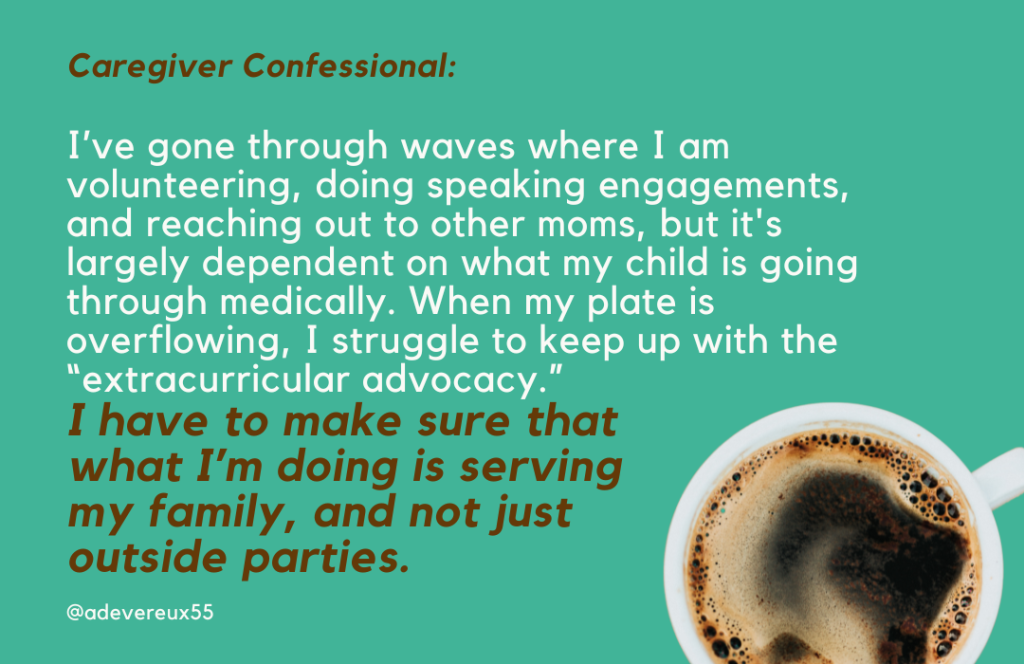
Advocacy in this stage: The advocacy flexed by caregivers during the F%$# Around and Find Out stage includes furthering our personal education and outward-facing advocacy like community organizing, supporting other caregivers, contacting lawmakers, researching grants for new research, or educating larger audiences to the needs of caregivers and our medically complex children, among other options.
The stages of the Caregiver Continuum are cyclical, not linear.
We all move through the different phases at different paces based on the unique circumstances of our lives, and some of us will never have the space to reach the “Eff Around and Find Out” stage, and that is okay!
We often cycle through the phases as the needs and circumstances of our lives change, often finding ourselves right back in the “Survival” stage when we least expect it. And even when your life feels less intense, you can hold space for the times that you were going through much more traumatic phases.

No matter where you find yourself on the Caregiver Continuum, you are doing enough.
If you’re just managing to make it through the day trying to support your child’s health and well-being, you are doing enough.
If you can’t add anything else to your plate until you feel more stable in your own mental health, you are doing enough.
When you have more energy, educate yourself and others around you.
When you have more help, take more time to work on creating societal and systemic change.
When you have more space, walk newer caregivers through the difficult entrance into this life.
And when you don’t have the capacity, give yourself grace understanding that we all cycle through the Caregiver Continuum stages as long as we are caregivers.
So Caregiver, where are you right now?
And what grace are you giving either your current self or yourself from a previous stage today?

1 thought on “What is the Caregiver Continuum? The Framework That Explains the Caregiver Experience”