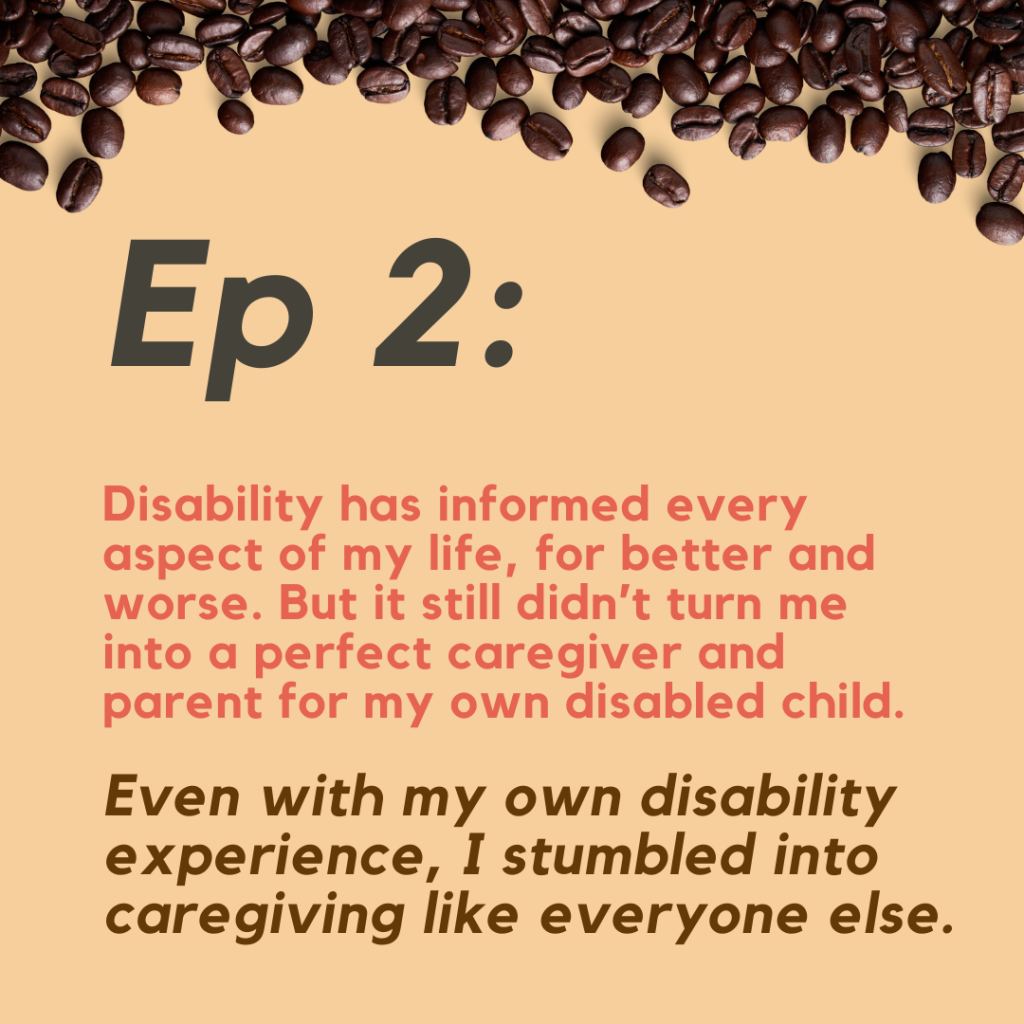
Erica and Alyssa get super vulnerable and share their own experiences of growing up as disabled children. We talk about our disabilities, the many feelings that come with growing up in a noticably different body, our complicated feelings on being seemingly “less disabled” as adults, and the way our experiences with disability have informed our whole lives.
This conversation is not one where we claim authority over anyone or superiority over any other kind of caregiver. Instead, we’re sharing our experiences to give all of us a more well-rounded view of disability and caregiving. We’re so glad you’re here!
In this episode:
[00:29] What’s fueling us today (and Alyssa’s unconventional plasticware)
[03:45] All the caveats for this episode, from allergies to our place in the disability world
[09:13] Erica’s story of growing up as a child with disabilities and medical complexities
[14:23] Alyssa’s story of becoming disabled as an adolescent
[22:02] The uncomfortable questions that both disabled children and caregivers face
[28:27] The complicated feelings and internalized ableism both Alyssa and Erica navigate as adults who appear “less disabled” than they were as children
[33:23] The way becoming a caregiver to disabled children shifted both Erica and Alyssa’s perspective on their own disability
[40:31] The way experiencing disability shapes your entire worldwide
Links:
Follow us on Instagram for research, validation, and a lot of memes @caffeinated_caregivers.
Join our newsletter and get caregiver news, validation, surveys, and support right in your inbox <3
And if you have a sec, leave us a rating and review on Apple or Spotify! Thanks friends! Talk soon!
Finally get the support you need as a caregiver, right in your inbox:
Transcript: Ep 2: Cared for to Caregiver: How two disabled kids grew up to parent their own disabled children
[00:00:00] Alyssa And even the masking, right. You know, because like, you just get used to being in pain to the degree where it’s like, you know, doctors are like the normal amount of pain is zero. And you’re like, Huh, That’s interesting. The normal amount of paid for me is like, Can I walk today? I can walk today. Great. All right, That’s normal. That’s.
[00:00:29] Erica Welcome to Caffeinated Caregivers, where we are just two friends having a coffee date and a conversation about all things related to caregiving. Erica Stearns here with Alyssa Nutile. Oh, is it? I just let it go from a very large what looked like a flower vase filled with iced coffee. Can you please explain to me what’s fueling you today?
[00:00:52] Alyssa It’s not it’s not a flower. These are water glasses, technically. I mean, they’re like drinking glasses.
[00:01:01] Erica I mean, that’s what a flower vase is.
[00:01:03] Alyssa It looks like a flower vase. It’s very wide. I’m not sure if it’s 24 or 28 ounce glasses, but they are large. And I did not fill it all the way to the top with coffee. It started about like two thirds full. And now I’ve drank.
[00:01:20] Erica Easy.
[00:01:21] Alyssa To, like, maybe halfway.
[00:01:26] Erica Just the kids we need to show them. It looks delicious.
[00:01:29] Alyssa It is delicious. It’s the same coffee I was drinking for our intro episode, though. It’s just homemade cold brew with a couple ice cubes and a little bit of the Starbucks caramel macchiato cold brew mix that they sell at the grocery store. And that’s it.
[00:01:45] Erica Well, today I am fueled by or I should say this podcast is made possible today by many forms of antihistamines allergy medications.
[00:01:58] Alyssa And yeah.
[00:01:59] Erica My typical cup of coffee in the morning. And there’s my dog. Yeah, I do this to me a lot to me. And I’ve got my English breakfast. And I realized while I was making this, I mainly drink tea as an excuse to drink hot lemon water because I put like half of women worth of juice in each cup of tea. I think it kind of relaxes my vocal cords a little bit combined with the hot water. So I love tea, but I’m mainly here for the hot women water and I like it flavored, apparently. So it doesn’t really taste like hot water. Oh.
[00:02:43] Alyssa I have never been able to get into tea kind of for that same reason. Like, it just doesn’t. I don’t know that I really love hot drinks that much. Just generally like I drink hot coffee for a while just because, like, that’s the easiest way to get it usually. Right? Like just hot drip coffee. But I like cold drinks better. And so hot water with the white flavoring is just I know people like it, but I have never actually my husband used to be a coffee drinker and now he’s in his mid-thirties like I am, and he can’t drink caffeine anymore. So he’s also switched over to decaffeinated tea. That’s what he drinks all the time. And he’s like, It’s really good. You should try it. And I’ll be like, Okay, I’ll try it and I’ll try his ginger lemon tea. And I’m like, Ooh, I can’t. And then I put my woman in and I’m like, Ooh, not better. And then I’ll add Honey, now it’s sweet and even more gross. And I just I can’t do it.
[00:03:38] Erica I actually enjoy tea. But if there is an option between the two, I will always default to coffee.
[00:03:45] Alyssa So should we go ahead and hop right into all the caveats we have for today, then? Because I think maybe the first caveat should be on your note about allergy medicine and herbal tea that we’re both very allergic to just the outside broadly right now to fall the fall.
[00:04:06] Erica Especially Fall.
[00:04:07] Alyssa Hey, Goldenrod, as soon as the leaves start coming down, I’m super, super allergic to mold, and I live in a very damp, cool climate, so there’s just going to be mold everywhere in about three weeks, and I’m not going to be able to breathe for like two months straight. So we’re trying really hard, guys, and we’re blowing her nose a lot and taking a lot of allergy medicines. But if you hear us sounding a little nasally, no, you did it.
[00:04:36] Erica This is a true story. I really love the fall. Everything about the fall buds. For most of my adult life, I have not been able to enjoy the fall. So it is a very complicated relationship that I have with the season. And it’s also pretty funny that we’ve decided this is the time to start a podcast when we both sound amazing.
[00:05:06] Alyssa We do sound amazing. Absolutely. It is ridiculous because like you said, I also love the fall, like I love leaf piles and I love wearing my sweaters and I get to get my boots out. But it has gotten bad enough that, like I was helping Sam, my husband bag up leaves and I came in afterwards and I had hives all over my arms and my chest and like, my face was swelling up. And so I was like, I don’t think that I can help you do this anymore. So anyway, long story short, now we have to pay someone to do our leaves every year, which is very annoying, but it is what it is.
[00:05:42] Erica You know, I’m at the age where I see the value in paying someone to do the things that are that are truly going to make me miserable. That makes sense to me that you’ve done that. With that said, today we’re actually going to talk about ourselves, which feels weird. You and I communicate frequently, and for the most part we are talking about systems, we’re talking about frustrations, we’re talking about advocacy, we’re talking about things we’re seeing happening in our community with caregivers. We hardly talk about ourselves. Which explains why I didn’t know for the longest time in our friendship that you also grew up with disabilities. You mentioned in the last episode that you had heard me on another podcast talking about my experience as a caregiver, related to my experience of having been a child with disabilities and having received care from my own mother. So you kind of come into friendship with that knowledge. But I didn’t really know that about you before we get into that, because that’s really what we’re going to cover today. We’re going to talk about our experiences growing up with disabilities, but as we usually do, we want to give the disclaimer, the caveat. That’s what we’re talking about today is just our experiences.
[00:07:04] Alyssa Yeah, we’re here, like Erica said, to share our experiences and we are not. Here to claim to be experts on disability, or I would say even to be leaders in the disability advocacy space, not because we don’t want to, but because there are people who are doing this work already much better, much more thorough. They’re much more qualified to speak on those things. So we’re here because I think both of us have decided that if we are going to talk about caregiving, knowing that we are two people who have experienced disability sort of sets the stage in a different way and might be a little bit enlightening for some of the ways that we talk about things. It might be helpful for other caregivers to have both perspectives honestly in one person, because we had talked about that before, how rare it is to find people who are both caregivers and have also experienced disability and received care in some way.
[00:08:05] Erica Mm hmm. I think it needs to be said that despite the fact that we grew up with disabilities, we still stumbled into caregiving like this was not a graceful expert experience on my end. I shouldn’t speak for you, but we’ve had enough conversations, and I know you feel the same. We’ve actually referenced it as like we landed face first into caregiving. So for those of you who are listening and thinking, oh gosh, is this going to be an episode where we are shamed for the things we did when we didn’t know better? No, that’s not what we’re here to do. We’re here to talk about how our experiences have shaped our caregiving. Let’s go into this. Let’s just dive right into some vulnerable stuff. Are you ready? I feel like I need a fuzzy blanket and a teddy bear or something.
[00:09:01] Alyssa A little bit. Yeah. I mean, yes, I’m ready. Let’s do it. Erica, do you want to start?
[00:09:07] Erica Sure.
[00:09:08] Alyssa Because I feel like you have a little more experience telling your story than I have experience telling my story.
[00:09:13] Erica So I’ll start. It’s funny you say that because it hasn’t always been that way. In fact, I didn’t tell my story at all. However, now I’ve learned and found that my story, my experiences are my power. And the way I learned that was actually in the nick view with my daughter. It was in the first few moments of her life when I knew because of all of my experiences. I knew something wasn’t right, and I started advocating for her. Which was interesting because as someone with disabilities who grew up in the eighties, I was not very good at advocating for myself at all. Like to that very moment. My history of self advocacy was really crappy from being honest. So I was born with congenital birth defects that impacted my respiratory and digestive system. It is called non isolated tracheal esophageal atresia that can look different for everyone depending on where the fistulas exists. I’m using a lot of medical terminology, but I feel like there are some caregivers in this audience that probably know exactly what I’m saying. To summarize it, there were holes in my airway and throughout my digestive system that prevented me from being able to breathe and eat or drink safely, which is pretty important. So very quickly, I received a tracheotomy and a G tube, and I had numerous surgeries to help repair certain parts of my digestive system and certain parts of my airway. This was considered a very rare disease at the time, or at least something that was difficult to repair. What is interesting to me is I never understood that as a kid until I met my college best friends who was eventually my roommate and learned that her youngest brother died from the same thing that I was born with. And that’s really when reality set in that I was lucky. I was lucky because the parts of my airway and digestive system that needed reconstructing could be done with not too much harm on other parts of my body. That just wasn’t the case for everyone. However, it left me with just one partially paralyzed vocal cord. So I’m always very raspy. I have a permanently sewn open airway and eventually, after many, many years of living with a trick in a G tube, I was able to wean myself off of those devices with the help, obviously, of my mom and, you know, a medical team. But at the end of the day, it was a lot of my own persistence. At some point in my journey, I was given the option to have a better airway or have a better voice. You couldn’t have both. And my mom was pretty incredible for allowing me to have the autonomy to make that choice at such a young age. And ultimately I decided to not do anything. So I think that maybe that was a moment in my childhood when I first advocated for myself, but I didn’t even realize that until many, many years later. Disability for me was visible. I had a tracheotomy, which was very visible. I audibly sounded different from everyone else. If I went out in public in a bathing suit, I was frequently bombarded with many questions about why there was like a road map of scars all over my body. That was really uncomfortable for me. That’s really when I learned the difference between someone asking questions because they’re genuinely interested versus someone asking questions because they’re curious and then learning how to respond to those rather intrusive questions was a skill that took many years to develop. For me, that worked out really well because by the time I became a caregiver of two disabled children, intrusive questions and navigating those I have no problem with now, I’ve been doing that since I was seven. So that was like a rich benefit that came from this. But yeah, that’s basically my life in a nutshell. So I was bikini listed at 15. That’s not where disability ended for me. That’s just there was almost like part one concluded and part two picked up, which was life as a disabled person, where my disabilities suddenly went from being very invisible to less visible and then figuring out how to navigate the world in that way. And I think that you have a very similar experience. So tell me about that for you.
[00:14:23] Alyssa Yeah. So to this day, I really struggle with coming up with like the language to adequately describe my disability and my hip disorder. And part of that is because I also I was asked about it constantly as a child, and I never had language to describe it then either. So let’s start at the beginning. I come from a family who has had like a lot of orthopedic joint injuries, particularly like hips and knees. My mom had leg Perthes disease. My aunt also had several hip replacements throughout her life. The unusual part of my story is that that’s actually not terribly uncommon for older adults to get joint replacements and to have joint injuries, particularly as they get older. My joint problems started when I was 12 years old, so I was in seventh grade and I played a lot of sports as a kid and I was having persistent hip pain and my mother is actually an hour nurse and she worked on a lot of orthopedic cases. So basically she would go into the hospital and talk to like the orthopedic surgeons that she worked with, and eventually they were like, yeah, she should get an X-ray. She should see an orthopedic doctor. All of that.
[00:15:36] Erica Kudos to your mom. I know. I feel like that’s like such a great first of all, I don’t know of a single person who does it do that when they work in the medical school? Yeah, we’re always asking the providers questions. I mean, it’s free information, but kudos to her for doing that. Like, talk about advocacy early on, she’s like, I’m just going to slip this into the conversation and basically get an evaluation without ever having to bring her in. I love it.
[00:16:01] Alyssa Yeah, She had her own experience with hip disease, so like she was a little more sensitive to it. But also, yeah, she was a great advocate. She’s always been a really good medical advocate for everyone in our family, including even for when she was staying with us and Gemma was in the nick you. That’s a story for another day. Anyway, so turns out I had a thing called Slipped capital femoral, a SIFI for short, because that’s a whole mouthful to say. And that’s also part of why I never explained it to people, because it’s a whole lot to say. But the short version is so you have on your femur, you have like the ball of your femur, and then the stem that comes off and there’s a growth plate in between. So for Skippy, the growth plate separates from the ball of the femur and the rest of your femur is like twisting in a separate direction from the head of your femur. And it’s pretty rare. And at the time, I had what was called a stable version, which is basically like it’s not actively moving, like it’s moved a little bit and it can cause some pain, but it’s the thing they monitor. So anyway, I got crutches and we were on vacation just like a couple of weeks after we got that diagnosis and I fell off of my crutches and that stable slumped capital femoral epiphany. This became unstable, slipped capital femoral epiphanies, which means like the two parts came apart. And so anyway, we got in the car, we drove back home, we drove to the children’s hospital, and I had surgery like two days later. And the thing with kids and joint injuries is that you’re still growing, right? So like, everything that they’re doing at the time is not so much that. Saying as much as stabilizing, it’s not impossible. But like kids who are 12 years old aren’t going to get a hip replacement unless it’s like extremely severe. And the other thing is that I was already like a really atypical case of scurvy. If you go and look out slept capital several prefaces and read up all of the risk factors on people who get that I don’t have any. And then when you also go and like read through the prognosis, I am like the worst case scenario for that too.
[00:18:01] Erica That is wild. Who knows if, like, there would have been a different outcome or maybe more aggressive treatment or intervention if you had fit like a typical bill of SCFE. Right.
[00:18:13] Alyssa Well, and even the masking. Right, You know, because like.
[00:18:16] Erica Oh, yeah.
[00:18:16] Alyssa You just get used to being in pain to the degree. We’ve talked about this where it’s like, you know, doctors do like the normal amount of pain is zero and you’re like, Huh, That’s interesting. Like, the normal amount of paid for me is like, Can I walk today? I can walk today. Great. All right, that’s normal.
[00:18:33] Erica Did you ever find yourself masking to also just avoid another procedure? Because I definitely did that that.
[00:18:41] Alyssa And even just like going to like appointments where they were just going to tell me like, oh, we’ll fix it when you stop growing, you know, it’s like I was like, What are we going to do? I’m going to go to this appointment. They’re going to like, send me to physical therapy. And then what? Like, you’re just going to be waiting again. I’m like, I can figure that out by myself. I don’t need to go to a doctor’s appointment to have that conversation. So basically what they do is they put a screw in through like the ball of your femur and they just hold the two pieces together. Most people, that’s the end of it. That didn’t happen in my case. Whatever happened in that cracking of the gross plate like my hip never recovered. So from the time I was 12 to the time that I had a total hip replacement at 18 years old, I never had like a pain free day. I had days that it was better, but I had some amount of chronic pain every single day. And people who have chronic pain, you’ll know how tiring that is. So yeah, the other thing that that left me with was a really noticeable limp, because since they’re not fixing your hip joint, they’re just stabilizing it. My femur bound was not in a normal position, so like, I didn’t have any internal rotation. I couldn’t really, like bend at the hip joint very much. So I had a really, really noticeable limp in conjunction with that. And that was the thing that just got worse. Like as I got older and my hip socket just got more and more destabilized. Like by the time I got a hip replacement when I was 18 years old, I didn’t have any cartilage left in my head because, like, the bone was more or less disintegrating. So anyway, that’s how I ended up with a hip replacement at 18 years old, which is not a thing that most people have. So that was like you talked about to cannulation as the end of chapter one. That’s very much like what my hip replacement felt like. I didn’t look at my hip replacement as the worst thing that ever happened to me. I was so excited to have it. I was like, Oh my God, I’m going to be able to move again. I’m not going to be hurting every single day again. I’m going to be able to do all these things that I could never do. I mean, that felt like its own kind of miracle, just waiting to get old enough to like, be able to have a hip replacement. Because you talked a little bit about having a lot of kind of intrusive questions. And usually like when people see a young I was a competitive swimmer, so like a young female athlete jumping around, they’re like, Oh my God, what’s going on? What happened? Did you get injured? And that was always a really tricky conversation for me to navigate, because usually when people see kids with injuries or what they think is an injury, what they think is like, Oh, you’ll be limping and then it’ll get fixed. And then like a week from now you won’t be limping anymore. And one of the most tiring parts of having to navigate this as a kid would be like one constantly fielding the questions about why am I limping, but then also having to try to explain to people that, yeah, this is just how it is. Some days it’s not going to be as bad because it doesn’t hurt as bad, but this is just how it is. And then people would be like, What do you mean? This is just how it is? And then that’s when you get into like the whole conversation of how much of my story am I required to tell you right now to get out of this conversation? A good chunk of me was just like, This is just how I walk. I know it doesn’t make sense to you, but this is just how I move around in the world. And that’s one thing to have from strangers. But what I was finding is that this would be a thing that would come up with people that I knew, you know, they would just sort of get used to like a small amount of length for any day that it would be really bad. They’d be like, Oh, what’s going on? It’d be like, It’s the same thing. It’s the same thing that’s been going on for the last four, five, six years. It is what it is. And that was exhausting about it.
[00:22:20] Erica I was going to ask you if you had a simplified way to answer that question or when, and if people asked if this was just an injury, were there moments where you were like, I’m just going to. I say yes, because that’s going to like, make this go so much faster. They don’t know me. I’ll never see them again. They’re not invested in this for any reason. That’s going to benefit me directly. So yeah, it’s an injury. Move on. Did you ever do that?
[00:22:46] Alyssa Yeah, I mean, I do that now, so I still swim because I really enjoy swimming, which means I wear a bathing suit, which means you can see the big scar on my head. But now, if people see it, I’m like, Oh yeah, I had a hip injury as a kid and usually, like, that’s what I leave it at because I’m like, I don’t have time to explain this whole thing to you.
[00:23:06] Erica Yeah. And I’m sure that it’s extra complicated to explain to yet again a complete stranger that this isn’t going away. Because that’s another thing about growing up with disabilities. You know, I was born in the mid eighties. You were born early nineties, 1990. Oh, the 90. Okay. So still themes weren’t great. Okay.
[00:23:31] Alyssa Right.
[00:23:31] Erica And, you know, I think it’s important to outline that that’s what we’re coming into. Our experience of caregiving with was a history of not having language like we do today. Most importantly, the word disabled. Melissa Did you ever refer to yourself as disabled?
[00:23:52] Alyssa No, I didn’t even know that was a word that could be applicable in my case. So I went to a private school, a relatively small religious school, so there weren’t really kids with disabilities there at all. Kids like our children just didn’t go to the school because why would you pay five grand intuition a year or whatever to send your kid there to a school that had like no special education teachers or accommodations or whatever, Right? So like, there weren’t kids like that in my school, so I didn’t have any language to talk about that. And I remember so when I went to high school, it was in a building that actually housed an elementary school and a middle school. Right. And high school was on the third floor. And there’s one working elevator in the whole building because it was still kind of like in construction at the time or there were three flights of stairs. And so my mom was like, oh, you can take the elevator. But then every time you show up to the elevator, you’re only supposed to take the elevator if you have a pass, right? Like, because like all the high school kids would take the elevator otherwise. So every time you show up to the elevator, you have a teacher like, Oh, why are you take an elevator? It’s like, Well, my hip doesn’t work. You know, they gave you that look. Like, what does that mean? Right? So I didn’t take the elevator. I just, like, limped up the stairs for three or four times a day. Again, as a 14 year old, the last thing you want to do is be noticeably different. So just the fact that there was no language at all, there is no community at all. There was no discussion, there was no cultural awareness whatsoever about things like that made it impossible for an already awkward teenager to want to differentiate themselves anymore. Right. Like I didn’t want to have to have accommodations for anything. So instead of taking those accommodations, I just struggled along and dealt with like significantly more pain that I probably had too.
[00:25:47] Erica I love that you mentioned the desire to not make yourself stand out as more different than you already are as an awkward teenager. I can relate to that in hindsight, looking back to when I knew that I was going to be accumulated, that was such an exciting time because it meant that I could be less visibly disabled, less othered. And of course that was happening in my teenage years, so I was thrilled. There wasn’t a lot of disability pride. If I’m being completely honest, I was fully ready to reject all parts of my disabled experience, hide them, not make it well known to people. If people ask me what was wrong with my voice. I would just tell them I was sick and move on. And I operated like that throughout most of my teenage years. And I think it’s because throughout my childhood, when I was more visibly disabled, I did experience a lot of bullying. It wasn’t a very happy experience. School was kind of the center of that. It was definitely the center of that, actually, because I never experienced that at home or with my family. I felt very loved, very supported at home. And then I’d go out to my community, which for me was school, and I would instantly feel othered and kind of the target of a lot of meanness and just cruelty. Kids can be really cruel, I think we all know that. So I was thrilled. I was thrilled to be able to like, hide those parts of myself as a teenager. And the whole reason I bring that up is because we now live in a society where things like disability pride does exist. And I am here for it. I love it. I’m just really excited that our kids get to grow up in a world where we can use the word disabled and know that it leads them to a community of peers who are also living with experiences like their own. That to me, did not exist, and I think it would have been such a hopeful thing. I think it would have been critical to my overall well-being as a child if I had a community, if I had a word that gave me access to my community. And unfortunately that just wasn’t the case when I was younger. But I’m thrilled that it’s in existence now that it’s happening now.
[00:28:27] Alyssa So on that note, I want to hear about this from you. We’ve both talked about like we had this moment for each of us, and I think we talk about it as a moment like you can relating and me getting my hip replacement like it was like the seminal point. And it was right. But I think probably for both of us, like, you didn’t stop having a ton of complications and symptoms and all that. The minute you can you wait it. And I didn’t have that with my hip replacement either. Right. Like, obviously you have to recover from surgery after hip replacement. But in my case, I had to also recover from six years of like muscle atrophy and tendon damage from living in a damaged hip prior to my hip surgery. Right. So it wasn’t like two months out. My scars are healed and like now everything is completely normal. It was another year or two before my limp went away completely. And I still have it, like here and there on like really rough days. But it was this moment, or at least for me, I was like, I am on the track to like being like, quote unquote normal again. I can all of a sudden do all these activities and be part of all these things that quite frankly, I felt like completely left out of beforehand. Don’t a lot of times it wasn’t intentional. It was just like, Oh, you can’t run, you can’t jump, you can’t move your leg. You can’t walk that far as a kid. Like, Oh, that’s really too bad. I wish you could come do these things with us, but you can’t. Sorry, It’s a lot of that. Like when you’re a kid, just all these things that you don’t have access to anymore. And then all of a sudden, as, like a teenager, you get access to that again and you’re like, Yes, this is the best day of my life because I don’t have to, like, have this thing following me anymore. Now I get to be normal and I can just leave all this other stuff behind. And you think that you think you can leave all the other stuff behind when you’re like 15, 18 years old or whatever you can’t. And touching back on what you said earlier, like the level of access to the world that we have right now and the few complications that we have now is not a guarantee, right? Because the reason that they don’t do hip replacements in teenagers is because hip replacements do not last the entirety of your life. Normal hip replacements. You get like 20 good years out of -14 years old already. Also, I have what was at the time an experimental hip replacement. So it’s not the normal material that is typically used in hip replacements. It’s not approved for use by the FDA anymore. So like, you cannot even get the hip replacement that I have now because people have had issues with it and they’ve had to have like early revisions. The reason we did it is because if I’m lucky, it’ll last longer. But I don’t know. I’m set up for at least one more revision in my life, maybe two. And they’re harder to recover from. And you have less mobility every time you get one similar to your complications. So all of that being said, we are in a state right now where like, I don’t feel, you know, quote unquote feel disabled unless I’m going through somewhere with a metal detector because I said that stuff off like fire. I can’t walk through metal detectors unless I’m doing that. Like, I don’t have a lot of limitations right now. I don’t have a lot of places that I can’t access. I don’t have a lot of activities that I can’t do. The world, for the most part, is like wide open to me and nobody really questions that anymore. And that’s a really weird space to inhabit now. Do you feel that like it’s very hard to like, make peace with saying something like, Oh, I have a disability, but you would never know that right now unless I told you that that’s that I think ablest part that comes out right, Like, oh, it’s not a visible disability, so you can’t claim it. But it does feel weird, like growing up in the way that we did where there was no language around it anyway. So like now claim it in a place where there is language but it’s not visible, really.
[00:32:31] Erica Speaking of new language, it’s definitely internalized ableism. It’s both of us feeling like we’re not disabled enough to claim that openly, especially in certain spaces where perhaps we are. Surrounded by people where their disabilities are more visible and they have less access to the world. After my children were born, specifically Margot, after I gave birth to a child with disabilities, suddenly everything became so clear to me. I cannot completely describe to you the transformation that took place, but suddenly I had more empathy for myself growing up with disabilities. I had more empathy for my caregivers. Suddenly disability. It wasn’t something I was ashamed of. It wasn’t something I survived. It’s something that’s a part of me. And I came to that realization because I saw my daughter, who is disabled and perfect in every way in my eyes. And it took me becoming a mom to have that realization, to have more compassion and a better understanding of a lot of the barriers that I went through that I probably shouldn’t have. We started this conversation with me saying that I was a great advocate for myself. Well, you better believe I am a fierce advocate for my daughter, and that advocacy for my daughter has taught me to be a better advocate for myself as well.
[00:33:59] Alyssa That’s so interesting that you mention that whole realization. There’s that thing when you have a kid, right? Like all these things that you aren’t willing to do for yourself or that like you think you don’t maybe deserve or whatever, you know, even if you don’t, like, consciously think that, like subconsciously you’re like, Oh, I shouldn’t need accommodation, I shouldn’t need this, I shouldn’t need that. And then you see your kid and you’re like, Well, they absolutely deserve every good thing in this world and you are going to give it to them. And how dare you even like, think for one second and anyone else that they don’t deserve that, right? Like, I would never be like, Oh, it’s like too hard to get travel to this place. So I guess she can’t have it. Like, no, absolutely not. Like, I will carry her up the stairs and somebody else will carry her wheelchair if there’s not whatever here. And also, you should get an elevator in this place. This is not ADA compliant. How dare you? And I do think that that would be it would feel much more foreign had I not had the experiences that I had growing up to just be like, No, she deserves to take up space. I deserved to take up space even when I didn’t as a kid. Looking back, having had those experiences, I do feel more empowered. I do want to say, though, that like it’s not only good things I don’t know about you, but one thing about having chronic pain every day for six years, like as an adolescent, is that you have to learn coping mechanisms, right? Because there’s not they’re not going to give you narcotics, nor would you want them at that age. But there’s nothing really that like makes the pain go away, right? So like one of my coping mechanisms is dissociation. And if you don’t know what that means in practice, it’s more or less like my whole nervous system shuts down. I get into a state where information can come in and I may be able to respond to it. I might not. But like there’s no emotional processing in the moment. That’s my default response because my body doesn’t have any more the mechanisms to like, take in emotional information at a time. So that was actually really detrimental when we were in the Nikko because people would be coming at you with all kinds of information and asking you to like, make quick decisions or doctors would give you information or nurses would give you information and they’d be like looking at me to sort of judge my response and there would be no response. The world is just kind of happening to you and you’re more or less like a passive observer at the time. And that was the pain coping mechanism to like, be able to shut out that side. And so I don’t want it to be like every part of my disability made me stronger or made me better or whatever. That’s not true. That’s actually a thing that I have to compensate for a lot harder now. Do you have moments like that where you’re like, Maybe it would have been easier if I didn’t have to do this?
[00:36:44] Erica Absolutely. You and I have both talked about how we have each had more surgeries than either of our children. Having grown up with our disabilities and going through those surgeries, it just was life. We didn’t know any differently. Like, just I didn’t even think or know that going to the hospital as much as I did wasn’t a regular experience for other kids. However, watching our children be hospitalized, watching our children be rolled away for surgery, which fortunately they haven’t had many watching them, you know, experience the illnesses that they do, having to watch them have a seizure that has been more challenging, more difficult, more trying for me than I recall experiencing it myself. Because when I was younger, it was just a part of life. Think this really sets the stage about caregiving and how that is very different from the disabled experience, but it is very much intertwined. How much we didn’t realize perhaps our parents went through watching us go through hospitalizations, surgeries, going to school and into our community with disabilities.
[00:38:03] Alyssa Yes, Yes, I can relate to that. I said something to Sam the other day talking about just broadly experiencing trauma as a caregiver and how, like I understand what it’s like having gone through surgeries on my own. But he said something. He was like, You’ve experienced it because you’ve gone through surgery on your own. But he’s like, I have experienced it, too. Now, Sam has not had major surgery really, ever in his life, but he’s like, I experienced it, too. So we’ll get into this on another day. But my daughter Gemma has had multiple surgeries, including three brain surgeries before she left the NICU. And two of those surgeries were to fix the first botched surgery that did not heal. So on two separate times, I had to watch my daughter’s scalp split open and pop out stitches and have like parts of her skull exposed, which I watched, including the second time, which I watched every day for every 15 minutes to try and figure out if that’s what was happening again or if it was healing. Spoiler alert it was not healing. That was right before her third surgery. And so I understand that, like her life has been traumatic for her. But to Sam’s point, I’m not sure that there are words to really adequately describe how traumatizing that experience is for a parent watching that and being completely helpless to fix it. So. Yeah. Like I would go back and do all of my things all over again, like three or four more times. If I thought that that would have saved her those kind of experiences.
[00:39:41] Erica I mean, the reason that I don’t feel the same way about my own surgeries as I do my kids experiences is because my mother protected me from a lot of that. My mother was the one to prepare me, soothe me, calm me, care for me. And it wasn’t until I was a caregiver myself that I realized how much of that she held. How much of her allowed me. To cope better, to improve, to recover, to really survive. Yeah, I think that’s just a great stopping point because in our next episode we’re going to be talking about that experience as a caregiver. So alongside do you have any final thoughts for today’s episode?
[00:40:31] Alyssa We had just talked about how like this is supposed to be like a short episode, and I thought it was going to be a short episode because I thought I didn’t have a lot to say about disability, and I was wrong about that. And I think that’s part of maybe where we’re coming to this from too, is like thinking maybe not consciously, but sort of like having this idea that like, Oh, we’re kind of over our disability. It’s like not a thing that impacts our daily life and whatever. And then we had this whole conversation, and I’m realizing that like, actually it’s informed my entire life and still does in this day. And I think that that’s been really enlightening and does sort of change, not the way that I look at my daughter, but it does sort of put in perspective a lot of the decisions that I’ve made for her in a lot of the way that I’ve navigated her care and continues to do that. It’s part of life. So many aspects of our disability have informed not just the way that we caregiver our kids, but our entire lives, right? Like the activities that we chose to do, the career fields that we went into. The college that I picked out every aspect of my life for the most part, has at least been informed by the disabled experience I had as a kid. You know, it’s part of life and it is right. It is for our kids, too. But to your point, the fact that, like we have access to things that like tons of other people like don’t still have easy access to is absolutely my biggest discomfort in using the word disabled at all because it’s that sort of imposter syndrome, like, Oh, it’s not enough. And I think that also wraps back around the part of why, like, yeah, we’re not claiming to be a leader or even maybe like be a voice in this community really at all. We’re just talking about this today again to sort of like maybe thread the needle between the two communities. And just to say that, like I have some understanding of what it is to be disabled and I definitely have a huge understanding of what it is to be a caregiver.
[00:42:33] Erica And that one has shaped the other like undoubtably.
[00:42:37] Alyssa One has shaped the other. Yes. And so I would just say we’re not here to tell you what to do, but I would you know, if you are a caregiver, I would maybe if you’re still in the stage where you’re trying to, like, make sense of this life. And I think a lot of us are forever. Maybe you look back and consider your life experiences. Even if you wouldn’t claim any space in the disabled community. Look back on your life experiences and just think about how what you’ve gone through has informed the way that you react and go through parenthood and caregiving. Now, like, I think that might be a really valuable insight.
[00:43:12] Erica I agree. And on that note, I think it’s fair to say that when we think about how disability still informs us today, it’s informing us with the content we create. We’re thinking about this as to people with our feet in both spaces. And, you know, I just want everyone to know when we create content that we are doing so very carefully because we understand that when we exist in both spaces, that brings an added responsibility to make sure that we are respecting the communities in both of those spaces. Well, I can’t wait to talk to you again. I’m sure we will have a lot to say about the topic of caregiving.
[00:43:51] Alyssa We always do.
[00:43:54] Erica Two chatty broads, especially when coffee is involved.
[00:43:57] Alyssa Oh, absolutely. All right, Erica, till next time.
